July 13, 2019
Today was going to be another exciting day. After breakfast we went to the train station. The train station is owned jointly with VIA rail and Parks Canada.
We listened to a presentation by Florence, a Parks Canada employee. Florence is a Sayini Deni, one of the two major indigenous nations that live in Churchill. Florence has the support of the Parks Canada to tell her people’s story. She explained how the Deni is the original people that lived in the Churchill area. They are known as the caribou hunters and lived on the tundra and the shores of the Hudson Bay and traded with the Hudson’s Bay Company in the late 1800.
The other indigenous nation is the Cree who lived inland in the boreal forest and were trappers and hunters. The two nations did not get along and often had skirmishes that resulted in deaths. Of course they also traded with the Hudson’s Bay Company. Over the course of several years, the Hudson’s Bay Company was able to establish some type of truce between the two nations, however the Canadian government was beginning to establish more authority on the region and decided to move the Deni nation, through treaties, inland to an area that they really were not familiar with and did not suit their culture. They were unable to hunt the caribou and the children were sent to residential schools. Over time, the Deni began to suffer from depression and alcoholism.
The Deni population began to dwindle and Florence explained that they migrated back into the Churchill region. A nation of over 300 is now down to less than 50. Florence spends a lot of time explaining the history of the Deni to the youth of Churchill and through the elders, teaches the language and hunting skills to her grandchildren. She still traps on her grandfather’s trap line. Today both the Cree people and the Deni live in Churchill and other settlements in the area and the long time animosity has disappeared. Florence gave a heartfelt and informative presentation and it was well received by the Red Fox group.
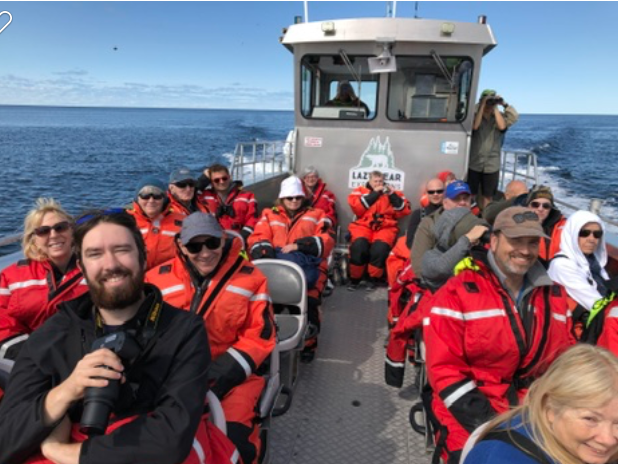
We returned to the Resort for lunch, and then boarded the bus to take us down to the docks. We were going on a Hudson Bay Coastal Tour. The owner of Lazy Bear Resort, Wally, owns a large flat-bottomed landing craft. The boat is named the Sam Hearne. It is powered by three, 300 horsepower outboard motors. Both tour groups boarded the boat, but before we boarded we were fitted into Helly Hansen Survival suits.
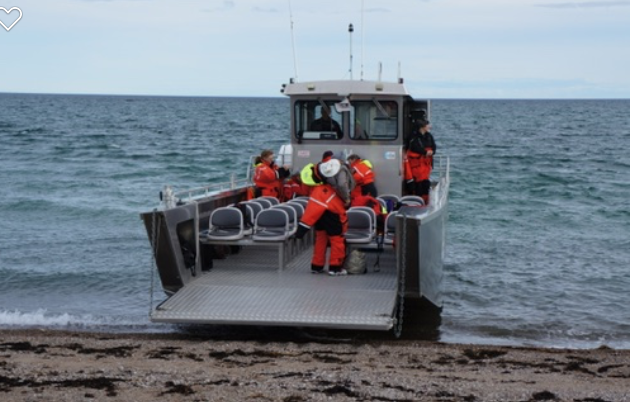
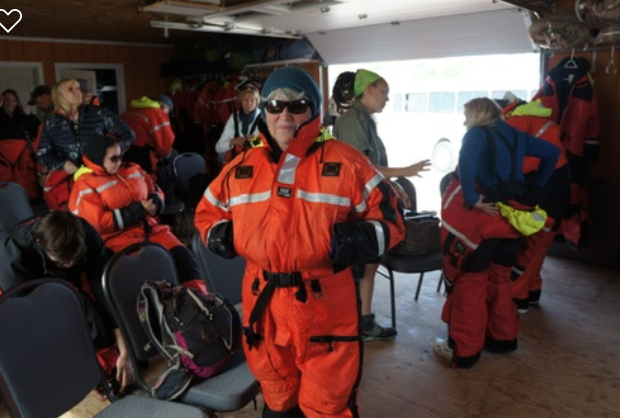
Wally gave us an introduction of the name of the boat. Sam Hearne the chief trader for the Hudson’s Bay Company in Churchill. He was an adventurer who travelled the vast region and made the necessary connections with the indigenous people. He was also aware that the French government was an enemy to the Hudson’s Bay Company and decided to fortify the trading fort and established Cape Merry as well as fortifying the actual trading post, which is now called Prince of Wales.
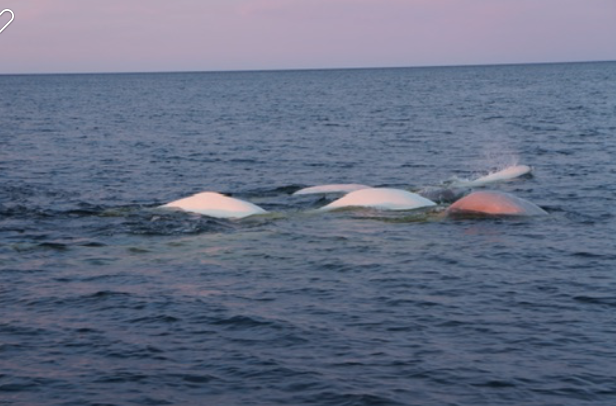
We started our journey in Sam Hearne along the coastline of the mouth of the Churchill River and Hudson Bay. We saw many beluga whales surfacing all around us and some came directly to the boat and slowly followed it, looking up at us, then turning upside down below the boat. The beluga whale is the only whale that does not have its vertebrae in its upper neck area fused, so it can move its head side to side as well as up and down. Several seals popped up periodically but we saw no other land animals.
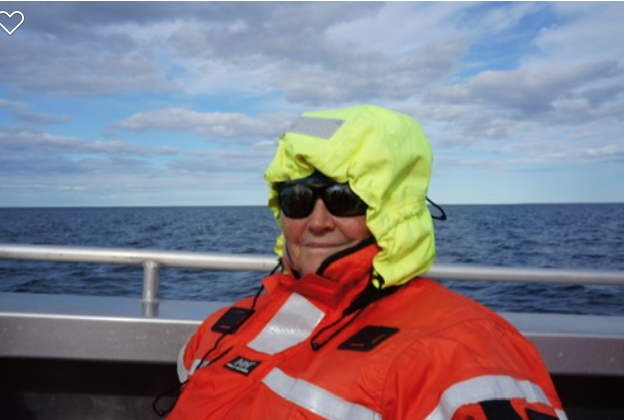
Wally then turned the boat north accelerated to 30 knots and we spend the next hour skimming along the water, wind blowing in our faces. We all were tucked comfortably in our survival suits and with our hoods on, were quite warm.
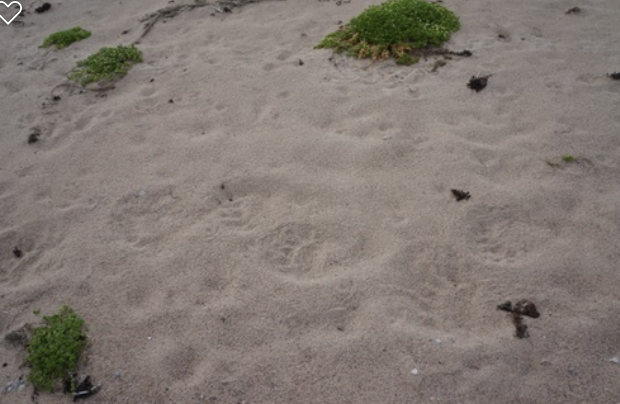
Our destination was Hubbard Point approximately 50 nautical miles north on the western shore of Hudson Bay. As we approached slowly we all were searching the shoreline for bears. Wally beached the bow of the boat onto the shore and Judd took her binoculars and her shotgun and stepped ashore. She spent the next ten minutes walking carefully along the higher ridges scanning the area for bears. When she felt it was safe for us to come onto land, we were warned to stay in a group and not wander off singly. We spent about an hour walking on Hubbard Point, and Judd and Jason pointed out interesting plants and rock formations. We found several bones and vertebrates of whales. Judd found polar bear tracks on the sandbar and we all marveled at the size of the footprint. It was at least 8 – 10 inches across the pads. It also increased our awareness that it could be in the area. We then discovered an area of grass that had been flattened and a pile of scat nearby. Judd explained that the bear had probably lain down in the grass. The flattened area was at least 7 – 8 feet long, and 5 feet wide. The scat was unusual, as it contained berries and seeds. Polar bears seldom eat during the summer and therefore do not defecate.

Wally remained on the boat as we wandered on the point and then announced on the loud hailer that what appeared to be a log on the small island adjacent to the point was actually a polar bear. We all looked at the log/bear and as we looked at it, it raised its head- it was a polar bear! Wally told us to continue exploring the point and then when we return we would go to the little island to look at the polar bear. We found small holes that were dug into the sandy banks and Judd explained that they are the entrance to the homes of the Arctic Ground Squirrel called a Seeka. As we were looking at the holes one popped out of a hole nearby. We all stood perfectly still and it ran towards us, stood up on its hind legs and scampered back and forth on the dunes looking at us with curiosity. It is dark brown in color and looked like a small marmot.
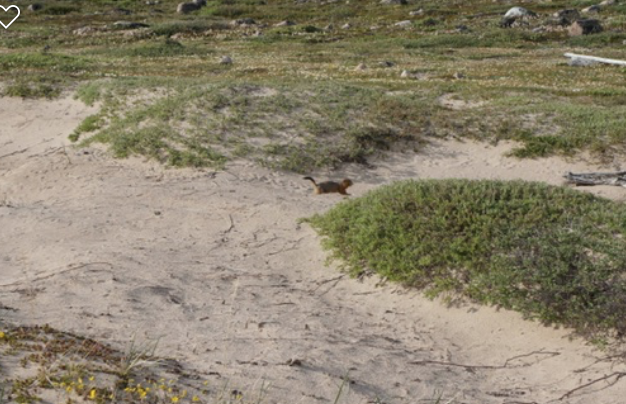
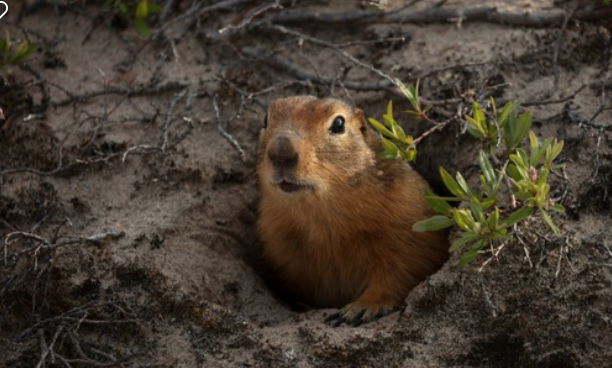
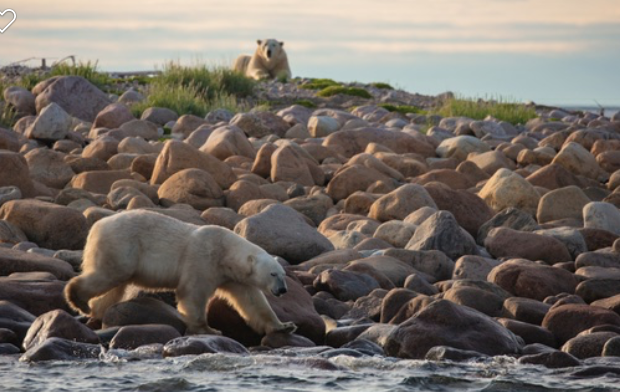
We eventually climbed back onto the boat and Wally took us to the edge of the adjacent island. As we approached the rocky beach the bear looked up at us and suddenly there were two polar bears! One of the bears got up and slowly made its way towards the rocky beach. Wally backed the boat up into deeper water and kept it there. The bear slowly came to the edge of the water and walked along the top of the rocks turning them over occasionally. Arctic terns flew back and forth over the bear’s head and Judd explained that the bear was looking for shore bird nests and likely eating the eggs. The other bear simply stayed on the high point of land, laying on its belly resting its chin on its fore paws watching us. They were an off white color and Judd thought that they had not been on land long as they would have been dirtier.

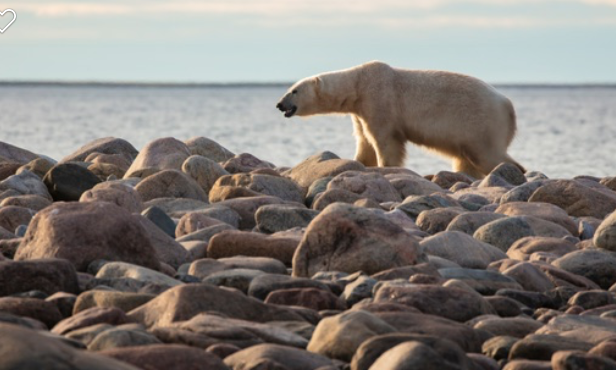
We watched the bears and took photos for about a half hour and then it was time to start our journey back to Churchill. Judd pointed out the white line of the sea ice on the horizon. She estimated that the ice was about 15 miles away and unfortunately due to the tides we had to return or we would have gone and visited the ice shelf.

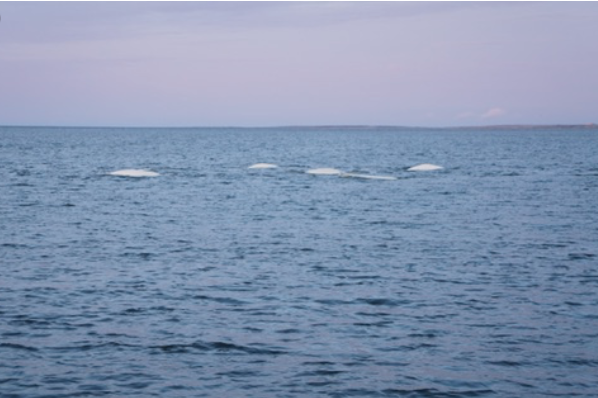
After another speeding, skimming, bumpy, one hour ride back we approached the mouth of the river, and because the tide was changing, the mouth of the river was teeming with belugas.Wally shut off the motors and we drifted towards Churchill with belugas surfacing all around us. Jason set up a pair of speakers and a hydrophone, and we could listen to the beluga squealing and singing underwater. Belugas are nicknamed “canaries of the sea” because of their underwater calls. They sound like birds chirping and tweeting. Occasionally you can hear them making clicking sounds, which Judd explained was their use of echolocation. The large bulb on the nose of the beluga is actually a large muscle that they can change the form of. The beluga sends out the clicking noise and uses the nose bulge to determine distance of the echo.
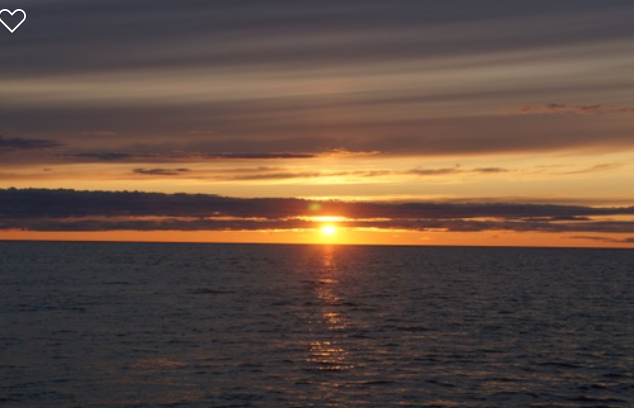
The sun was beginning to set and was providing a beautiful sunset and a backdrop to our excursion. The resort had provided box dinners for us while on the boat so we were not hungry. It was finally time for us to return to shore and Wally started the motors and quietly cruised back to the dock.
After we wriggled out of the survival suits and collected our things, we climbed back on the bus. Judging from the chatter on the bus it was evident that we all were in awe of what we had learned and saw today. Debbie and I enjoyed a warm cup of hot chocolate and then went to our room to fall into a deep sleep. Tomorrow was going to be another adventure!

 Quilting in a Kayak
Your blog made my day😎
LikeLike
Doug, you have to make this trip. It is awesome!!
LikeLike