Boy does time fly! Today we are headed for Newfoundland. We had reserved the ferry from Blanc Sablon to St. Barbe, on the tip of the northern peninsula. We dismantled the camp and headed for Blanc Sablon. Debbie and I had a lively discussion about the actual time that we should be at the ferry dock. Because we were still on the mainland, we were still on Eastern Standard time but the ferry was operating on Newfoundland time, ½ hour ahead. We stopped in at the terminal again just to confirm this and buy the ticket. We had some time before we needed to be back so we drove south of Blanc Sablon along the coast.
We were now back in Quebec! This is also a spectacular drive. This area is quite rocky with huge headlands overlooking the Gulf of St. Lawrence. We passed through Baie-de-Bradore, and stopped at a lookout to see if we could get a glimpse of puffins at the Perroquets Island. This island is a nesting sanctuary for puffins however, we are too late in the season. We are hoping to see them in Newfoundland. We continued on along the coast, and wound our way towards Middle Bay and then turned around to get back to the ferry on time. We enjoyed this short trip very much and it was a great way to end our time on the mainland.
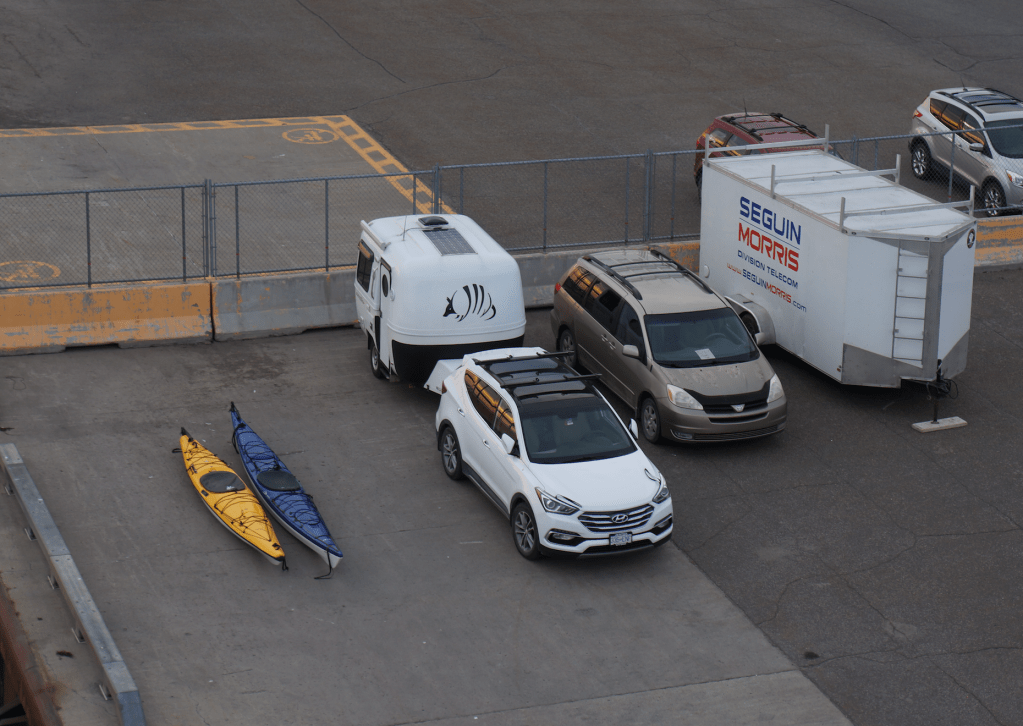
We joined the other ferry riders in the parking lot and waited for the ferry. The parking attendant told us that the trip last night had been cancelled due to high winds. The winds were still strong today but the ferry was working and so far our trip was not cancelled.
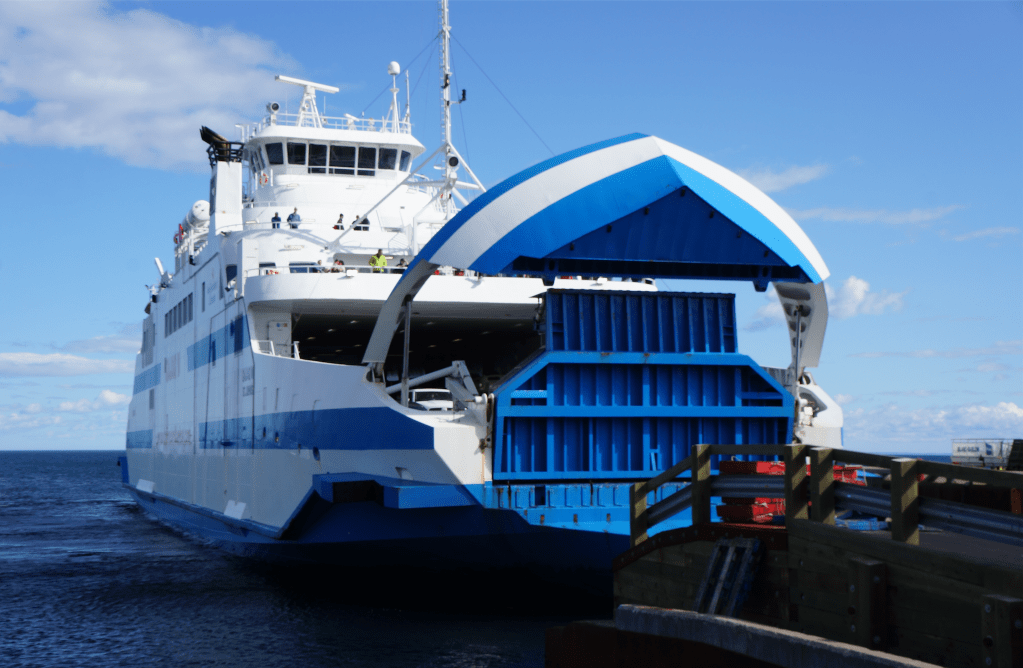
The ferry arrived about 20 minutes late but the loading was quite short as the ferry was less than half full for our trip. The trip across is one hour and 45 minutes and the boat was rocking the whole trip. The rolling waves were at least 4-5 feet high, but we chugged across safely.
Our destination is to go to Pistolet Bay Provincial Park however, because we arrived late in St. Barbe we decided to stay at a commercial campground in St. Barbe and head north tomorrow. It is not recommended to drive at night in Newfoundland because of the high incidents of crashing into moose. The campground manager confirmed this rumor. We had eaten a greasy meal onboard the ferry late in the afternoon so we passed on supper. Debbie did some laundry and I blogged until it was time for bed. We are now in Newfoundland and plan to be here for about a month.
It was a breezy night all night and the sound of the waves crashing on the beach was a soothing sound to wake up to. We talked about where we were going to explore today. There are several places that we wanted to see. We headed out after a warm shower. It was a typical east coast day with a strong steady wind blowing from the ocean. The route we were on is 510, which follows the coastline north. Our first stop is Red Bay, which is a UNESCO World Heritage Site. Archeologists have determined that this was a 16thcentury Basque whaling station. We visited the information center that featured the model of a Basque whaling station. We had missed the boat that would take us to the original site, however because of our time constraint we opted not to take it. Instead we went for a coffee and pie in a restaurant overlooking the bay. We talked to the owner who was born and raised in Red Bay and well established in the community.
We talked about life in this small community, especially in the winter. They experience up to 15 feet of snow! He told us the story of his 86 year old mother’s house. This past winter the wind blew over 150kms/hr and blew the roof and one wall off of her house and tossed it into the bay. She had lived in the house all her life. Unfortunately the stress of losing her house was too much for her and she died shorty after. The homemade pies that we ate were partridge berry pie and bay apple pie. Delicious.
We also wanted to visit Mary’s Harbor. This little community is tucked into a cove along the shoreline and is the jumping off point for a ferry ride to Battle Harbor. Battle Harbour was established in 1750 as a fishing port and is a preserved in time fishing village. It is a National Historic Site. The ferry was not coming back until later in the afternoon which would not work into our schedule. We toured the village and enjoyed looking at the quaintness of this community.
We had travelled almost 200 kms north and we wanted to find fresh seafood for dinner tonight. We started our drive back and stopped in at West St. Modeste to buy a baguette at the local bakery. No such luck, but we bought fresh bread that had just been baked. We topped up the truck with fuel at $1.30/per liter. (This is the highest price of gas since The Pas, Manitoba).
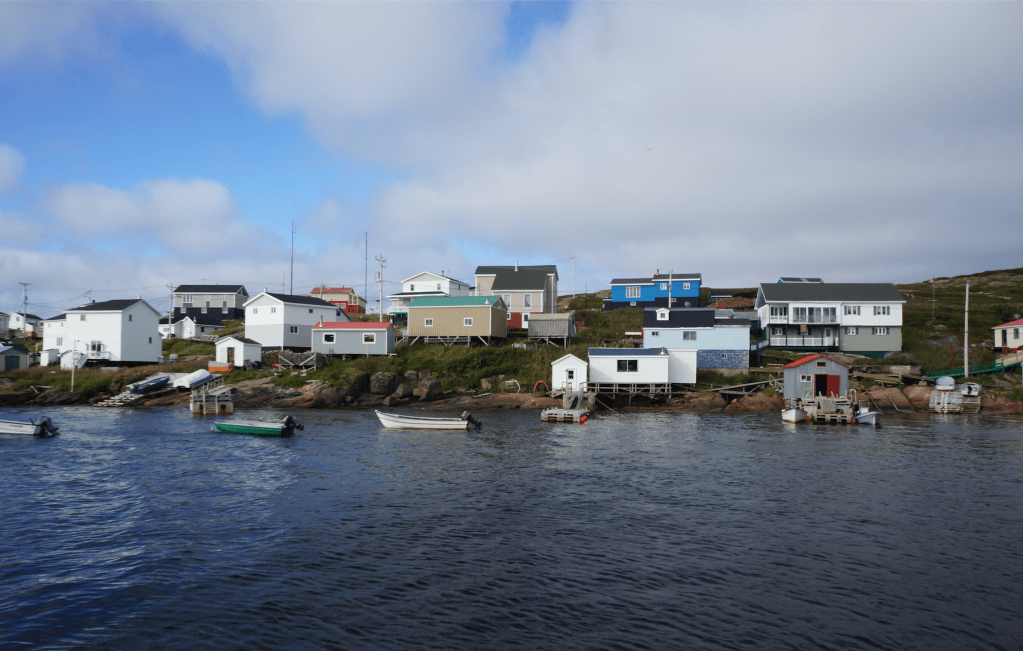
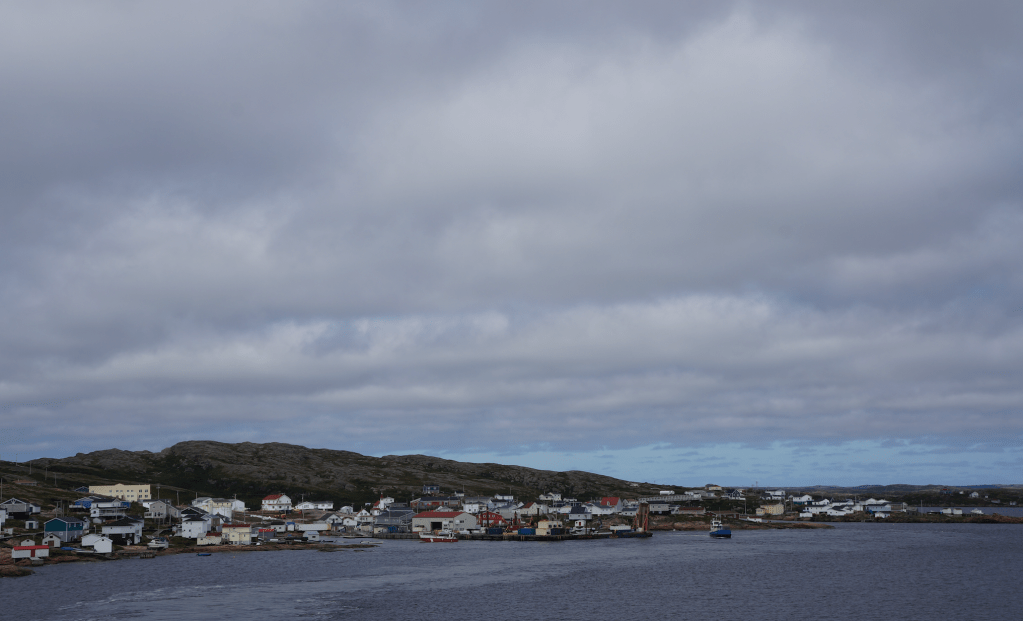
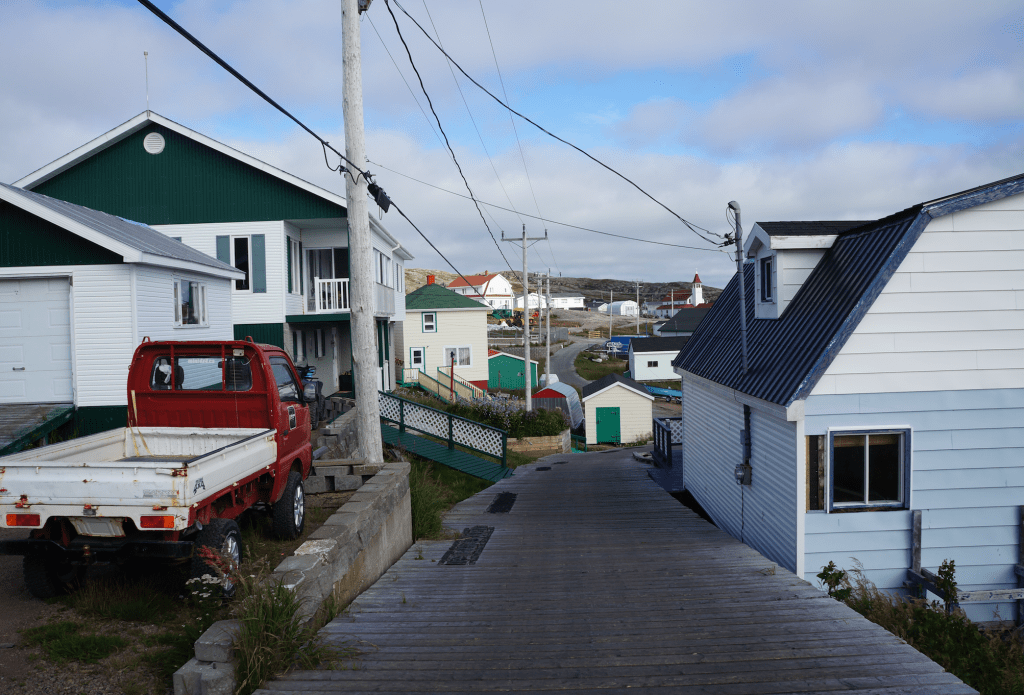
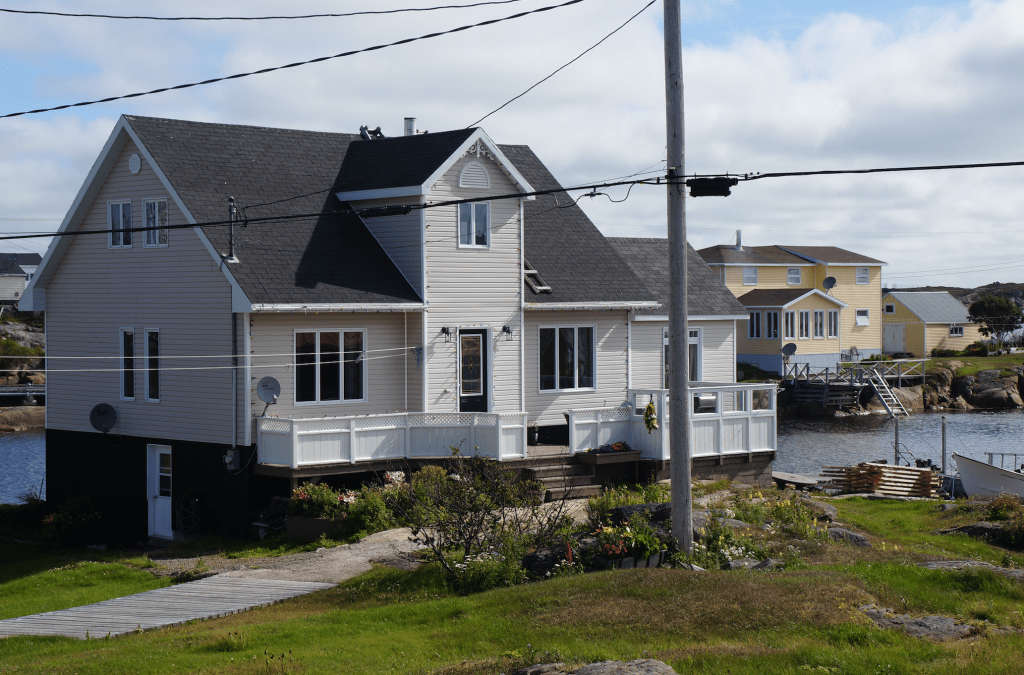
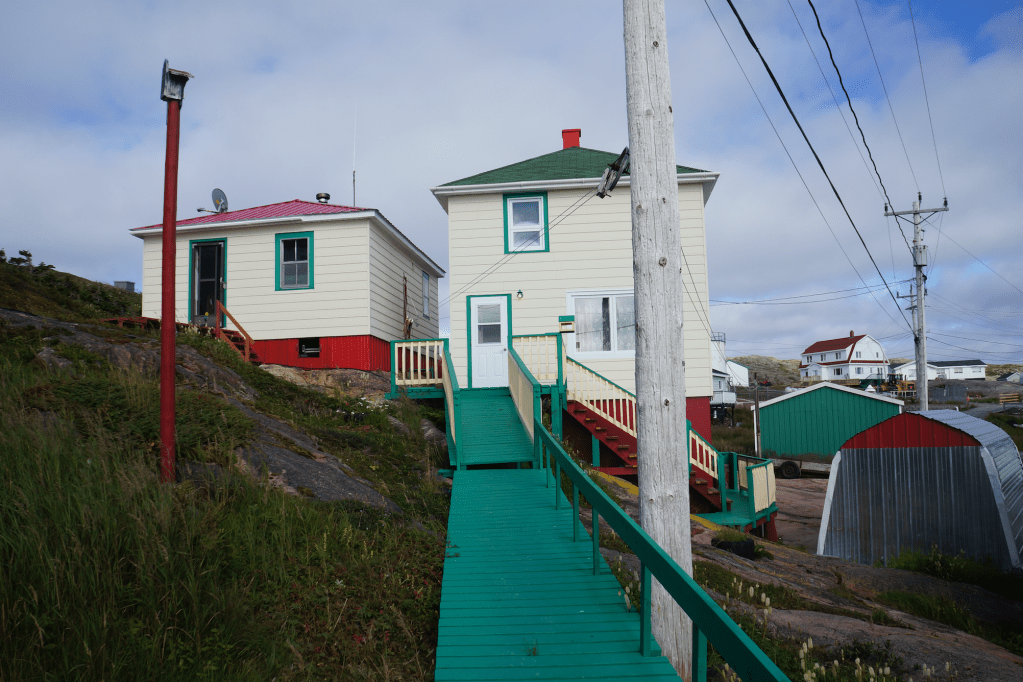
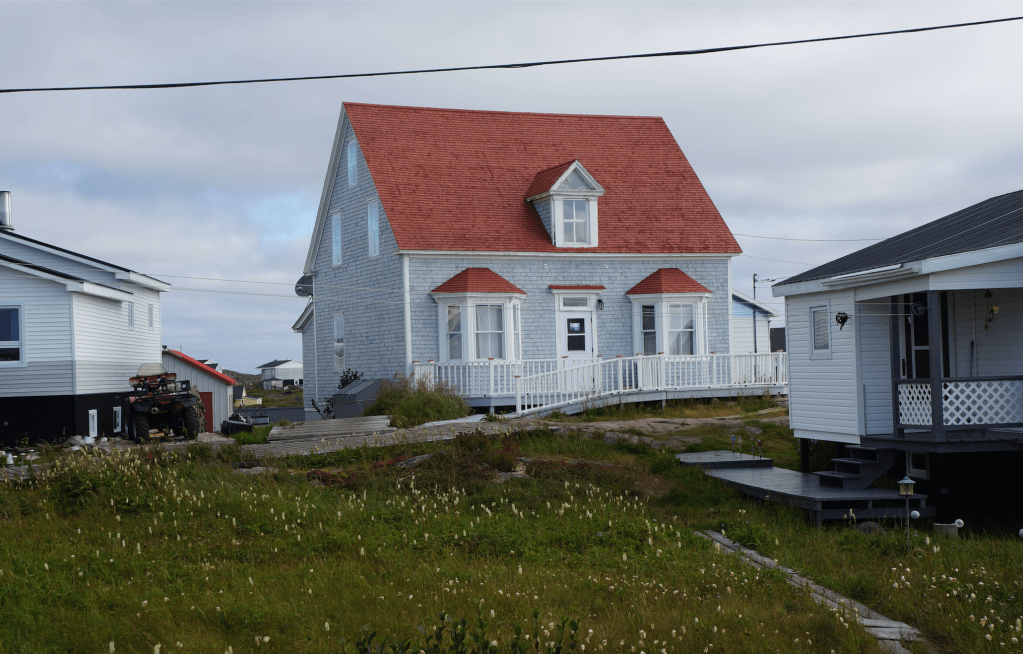
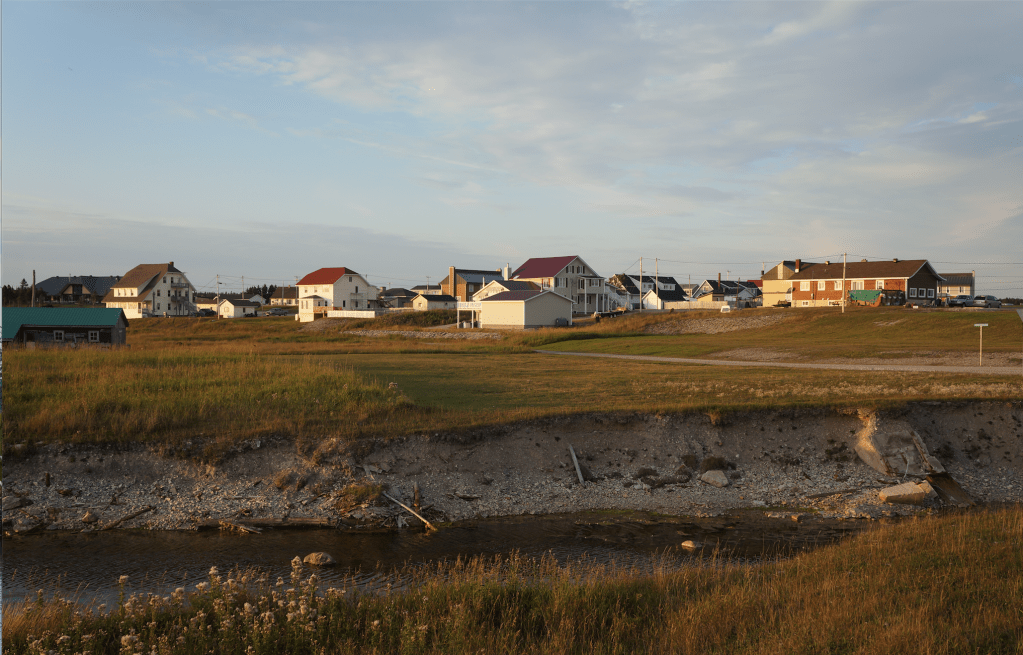
We drove south past Pinware Provincial Park and stopped in at the fish plant in L’Anse au Loup. They did not have mussels but they had “caught an hour ago” cod. We bought three fillets and then headed home. There are about five tiny villages just a few kilometers apart, along the coast. The homes are painted in bright colors, neat and tidy. The coastline is rugged with tiny bays and coves. Small skiffs and boats are either tied to a small pier, anchored a short distance from shore or sitting on their keels on the ground out of the water. The main industry is fishing but there are several other support industries in each village.
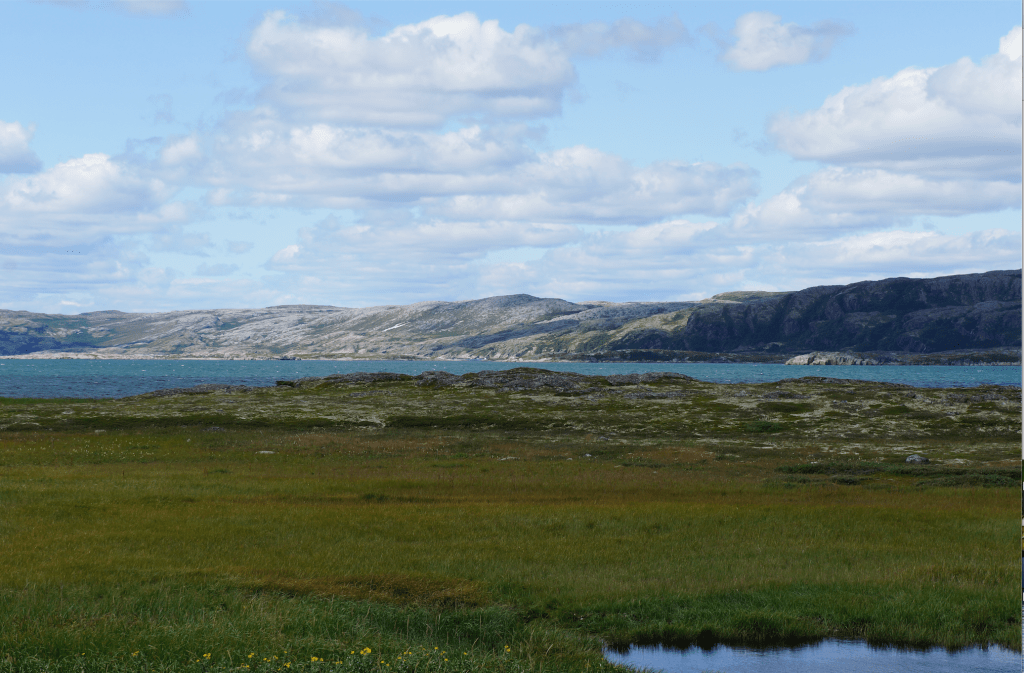
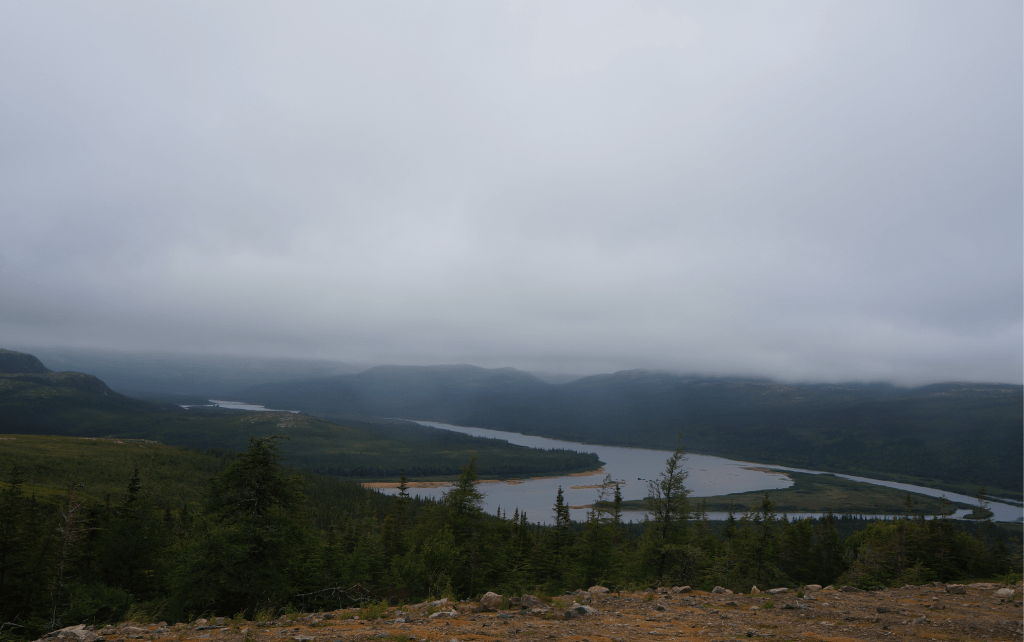
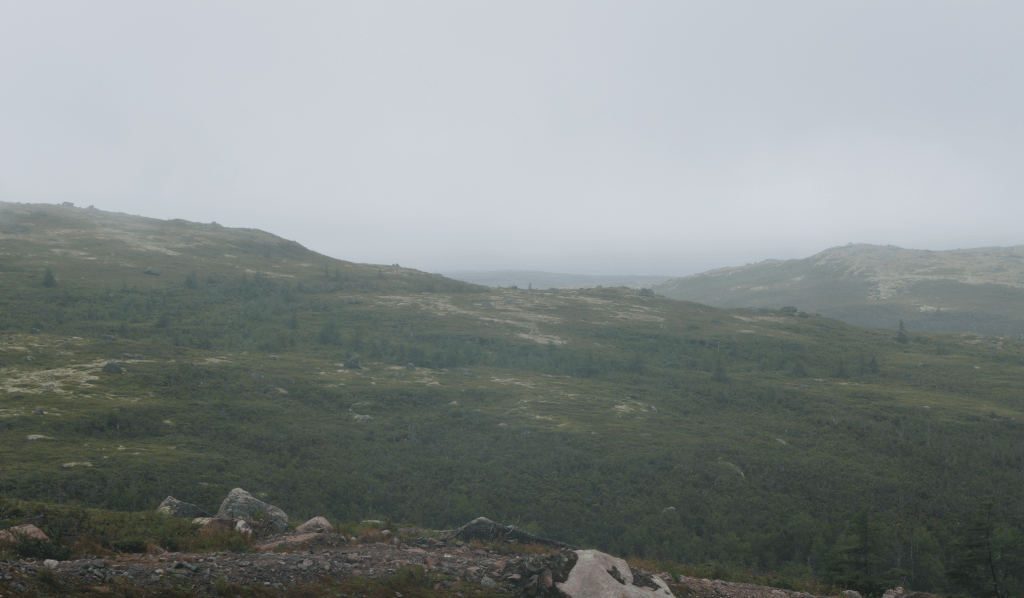
The road to Red Bay and Mary’s Harbor is paved and passes through two types of terrain, either the boreal forest that stretches along most of the road, or suddenly you pass through the sub-arctic tundra and hillsides with very little vegetation pock marked with small melt ponds. As you crest a hill the entire vastness of the land is overwhelming. The tourist brochures boast about Labrador being the “big land”.
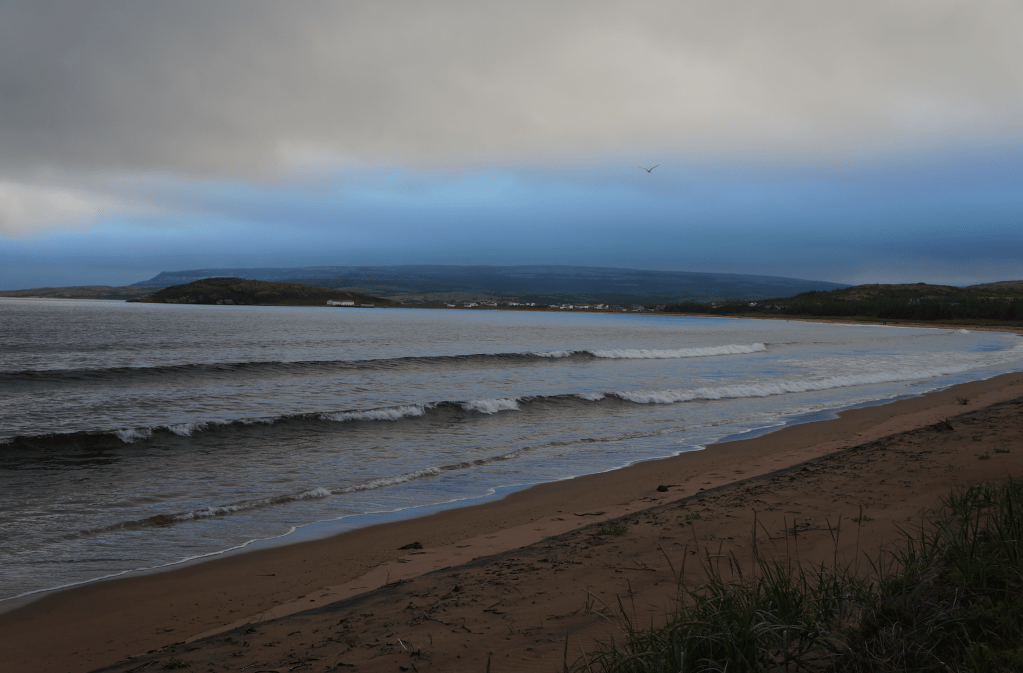
When we returned to our campsite, the wind was still blowing and the tide was coming in, bringing large rolling waves crashing onto the beach. Seals were bobbing off shore and gannets were plunging into the water. Debbie and I stood on the sand dunes and watched and admired the scene.
We fired up the barbeque and we baked the one fillet of cod, baked the potatoes in butter, onion and cheese all wrapped in tin foil. Robert came and visited us. He was also camping in the same campground, so we invited him for dinner. We had a few drinks, learned more about each other, and enjoyed a delicious meal. We talked until after 11:00 and finally decided it was time to go to bed. Robert will be staying in the area for a few more days before he too will be coming over to Newfoundland. We compared itineraries and realized that we would probably be crossing paths again on the “Rock”.
We packed up our belongings in our tote bags, left them at the purser’s desk and went in for our last breakfast aboard. It was a bit sad to say goodbye to so many folks that we had met on this trip. We sat with Robert who is travelling solo and also going to Newfoundland. He had visited Newfoundland before and had enjoyed it so much that he was doing it again. He is from Georgia and is pulling a tent trailer. He had boarded the ship in Natashquan. We would be crossing paths throughout Newfoundland. Our other breakfast partner this morning is Dave Sevard. Dave is the local Liberal candidate and is on his election campaign travelling to all of the settlements. His home is Baie Comeau.
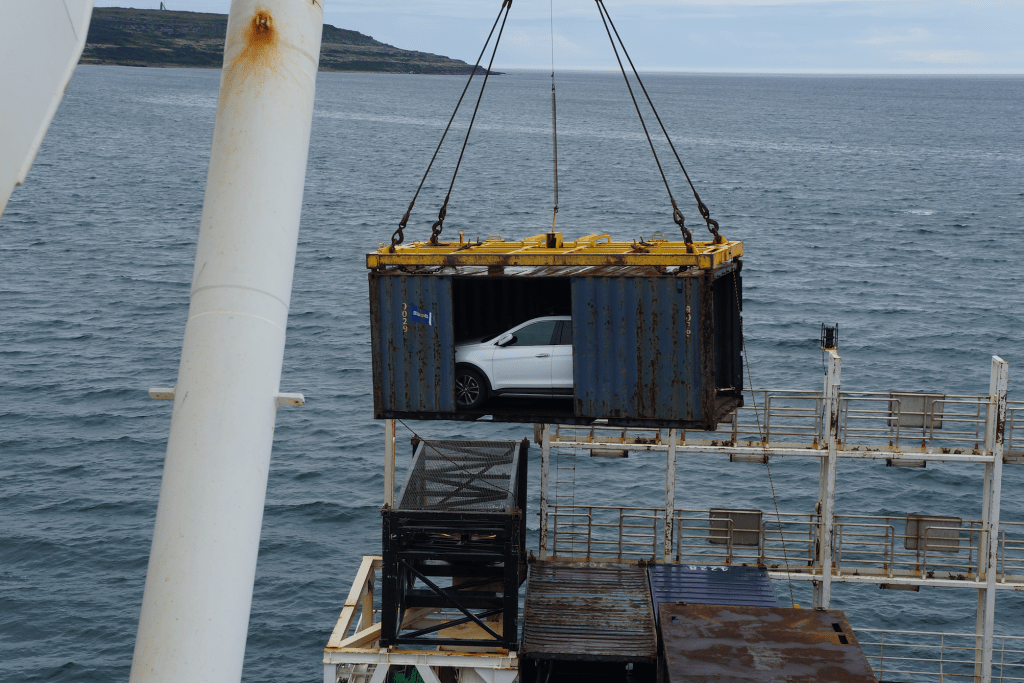
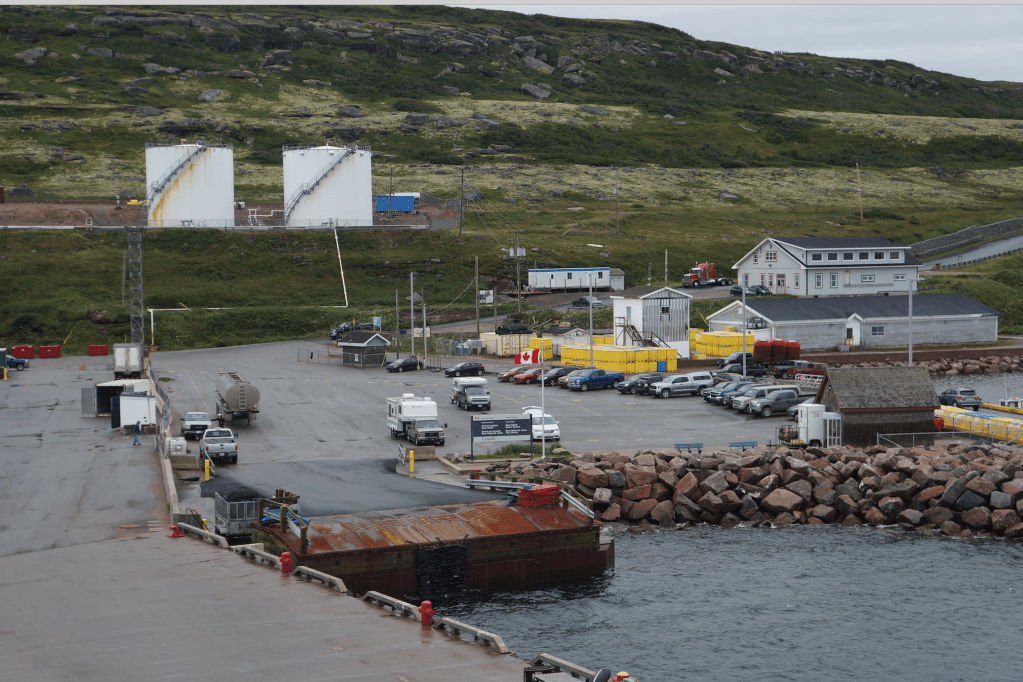
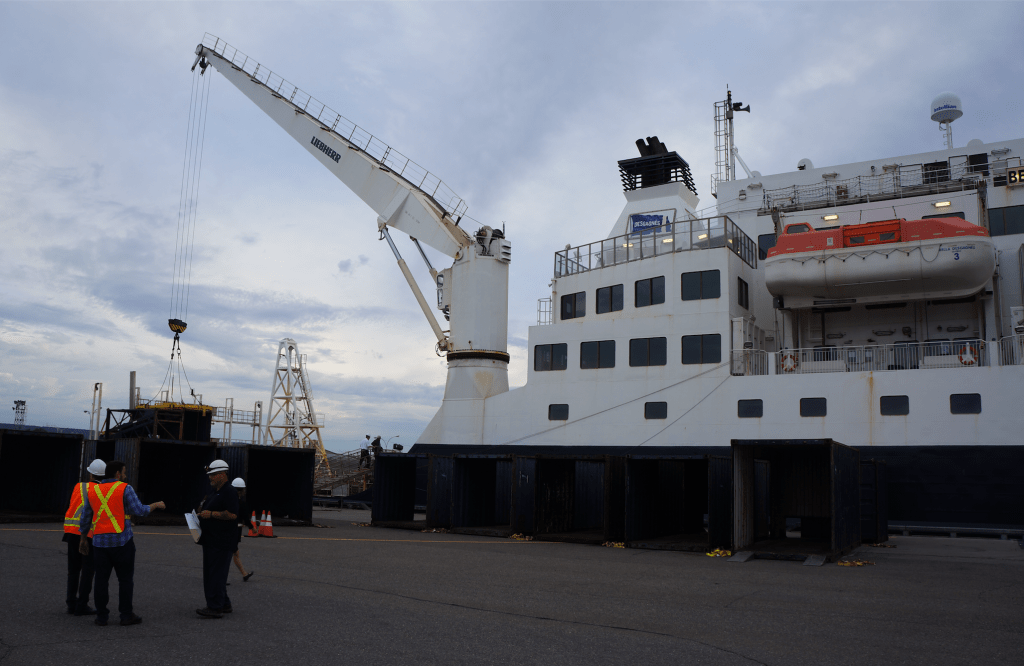
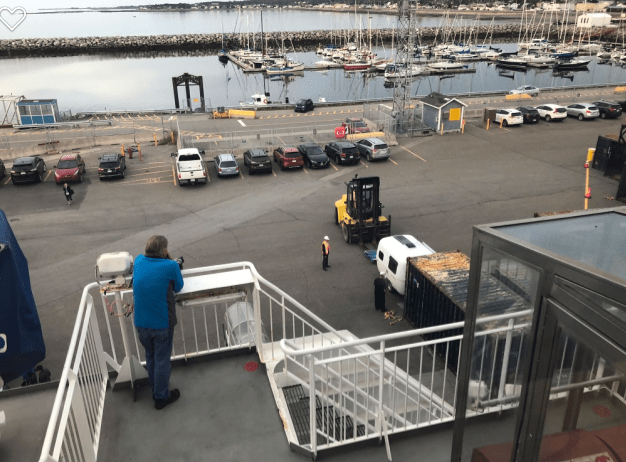
The crane was working hard to offload the containers destined of Blanc Sablon, including our truck and trailer. Many of the passengers who were not disembarking were taking an excursion into town so there was a flurry of activity at the gangplank. It was beginning to rain and Debbie and I sat up on deck 8 patiently waiting for our containers to be unloaded. Ours would be near the last to be offloaded. I finally saw our Santa Fe in the container dangling for the end of the crane’s hook and being lowered onto the dock. We went outside in the rain and I started to put the kayak racks back onto the truck, with the help of Wayne, who we had met onboard.
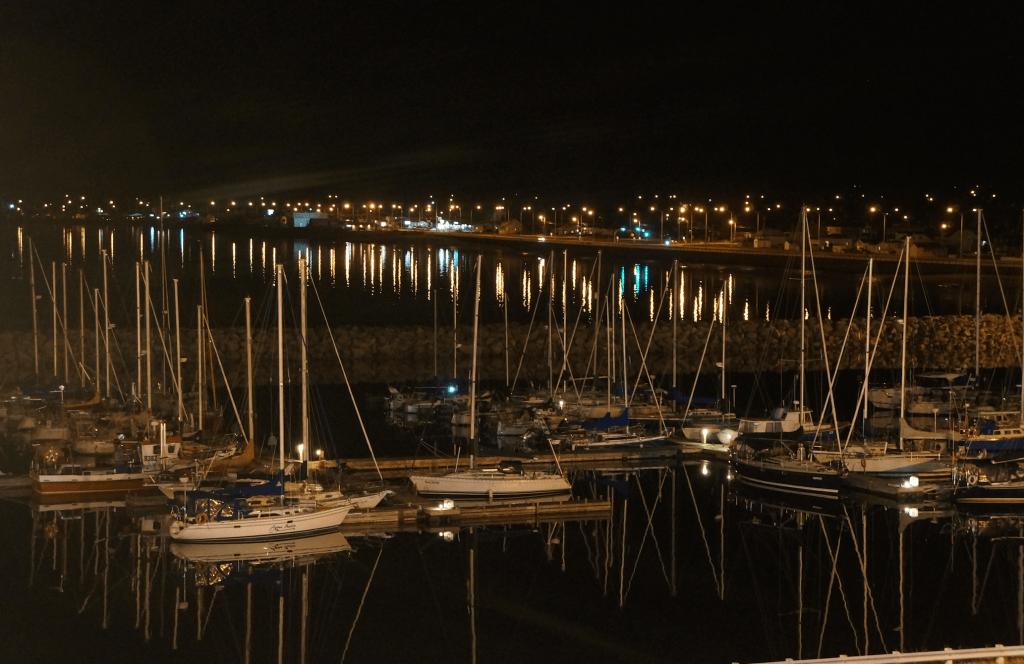
Blanc Sablon Harbor
Wayne and his wife Rita were making the round trip. Rita had taught school in her early career in an isolated settlement north of here. Wayne and Rita now live in Nova Scotia.
Finally the trailer’s container arrived and we also found the kayaks in a separate container just near our truck. In about a half hour things were loaded, hitched. Good-byes said, and we were off on the next leg of our journey. We stopped in at the ferry office next door to reserve a spot on the Sunday afternoon crossing. We had decided, after talking to folks on the ship, to spend a few days north of Blanc Sablon and explore the lower region of Labrador.
We stopped in at Buddies Groceries in Blanc Sablon and stocked up the trailer for the next week. After visiting the local Tourist information office, we headed for Pinware Provincial Park to secure a campsite and make it the home base for our travels in the area. We had several interesting places that we wanted to visit.
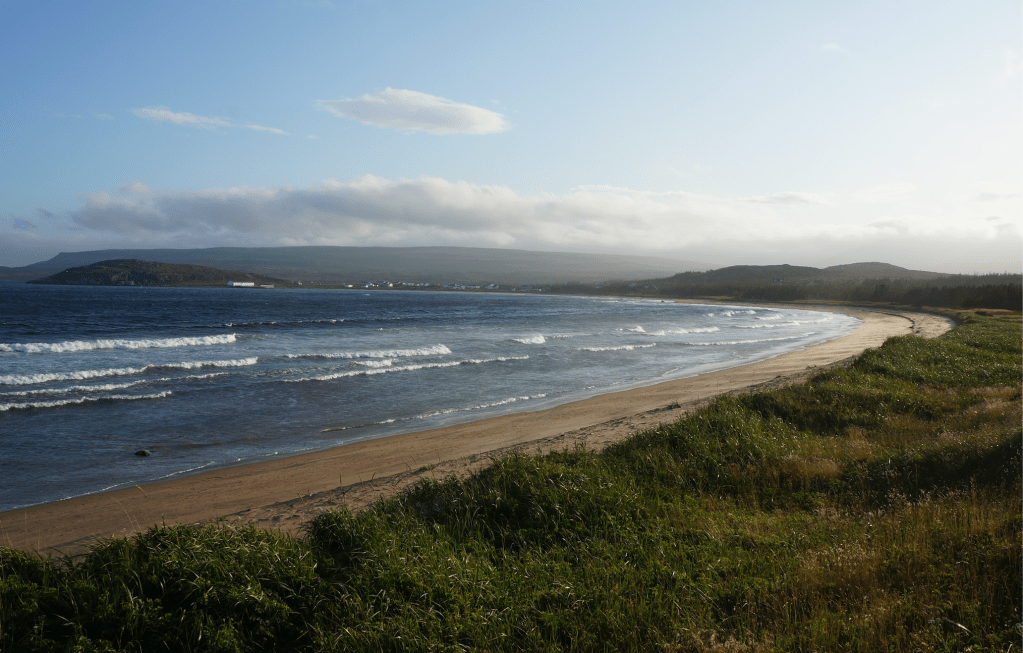
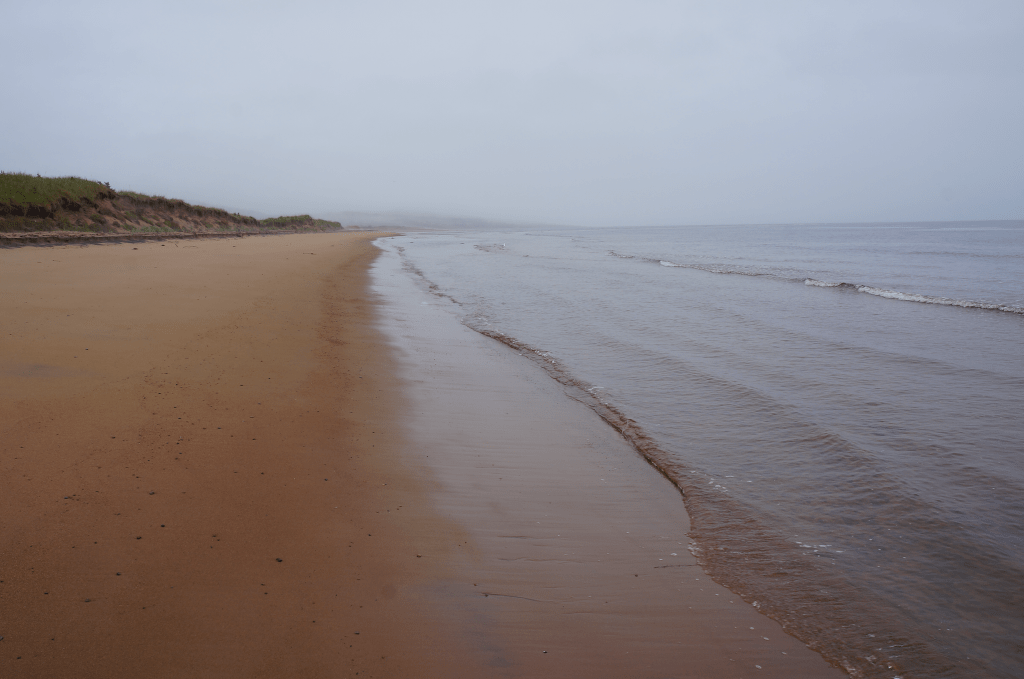
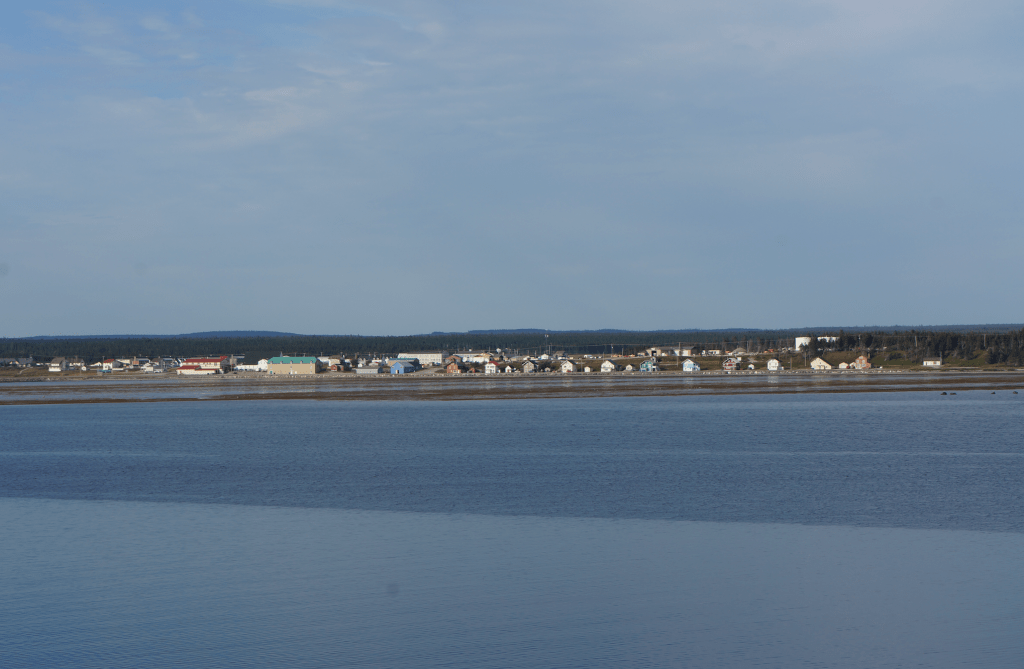
Our campsite backs right onto the bay and the waves were rolling onto a beautiful red sandy beach. You could see the village of Pinware across the bay. We were planning do some exploring in the late afternoon, but we were both tired and decided to take a nap. The nap was obviously needed as we finally awoke at 5:30! We walked along the beach in our mosquito netting jackets as the black flies had suddenly taken a liking to us. We watched several seals bobbing about in the water in front of us. Gannets were diving into the water, fishing. These birds fly about 50 feet above the water, and when they spot a fish, they fold their wings and dive straight down into the water. It was a magnificent thing to watch.
We were both hungry so Debbie cooked for the first time in a week and it wasn’t long after doing the dishes, a short read and some blogging notes and it was off to bed.
It had been a busy day and a very active week. We talked about our week on the Belle Desgagnes, and we both concluded that it was a trip well worth taking. We had seen some many interesting places in this part of Canada and had met so many great people. We agreed we will always remember this trip.
This morning we woke up and immediately went for breakfast. We were arriving right after breakfast into Harrington Harbour, and we left the ship as soon as it docked.
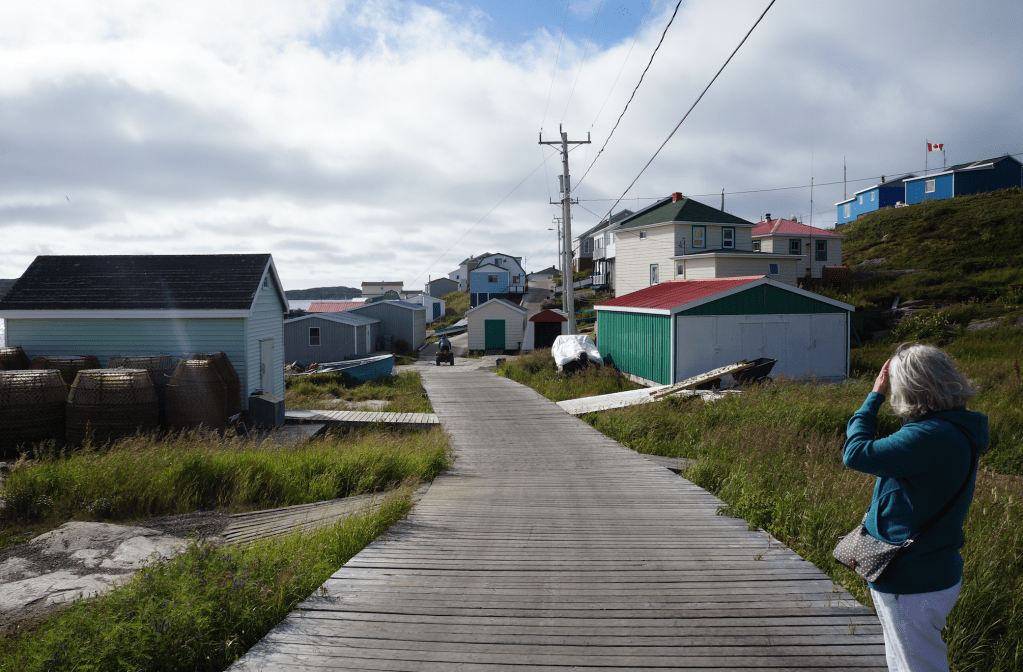
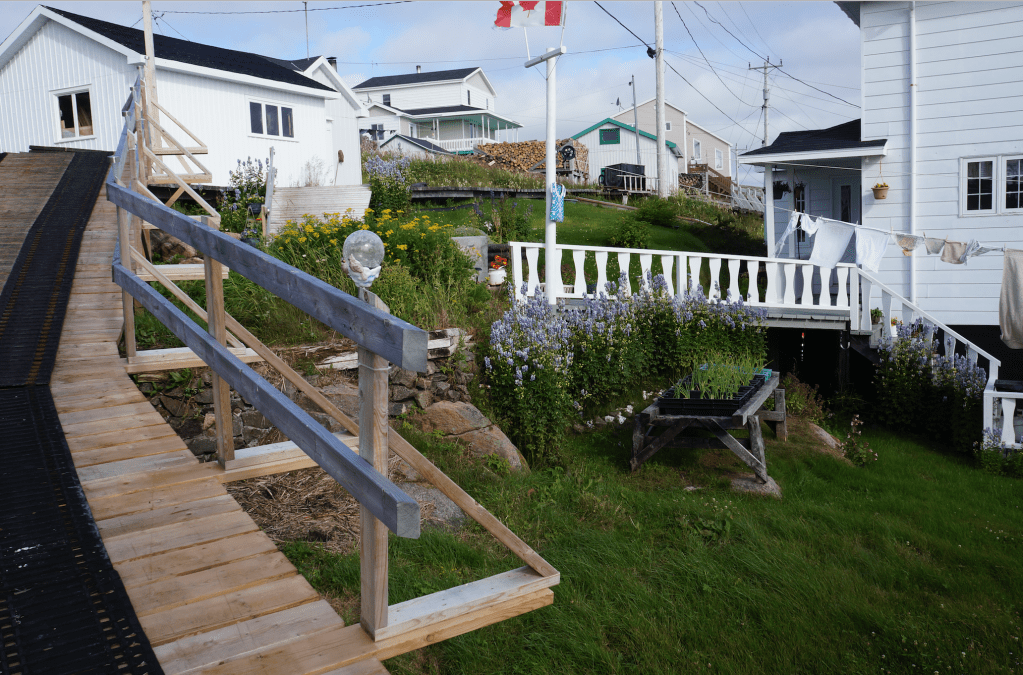
This colorful little community of 250 folks is a active fishing town and is located on a small island just off the coast. It is mainly English and Innu. All of the houses are connected with a wide boardwalk and at present the main harbor is undergoing a major construction. Two large barges are anchored in the harbor with large excavators are digging out the sea floor. The rocks are removed and brought ashore, sorted and stockpiled, to be used later to form the base for a new quay.
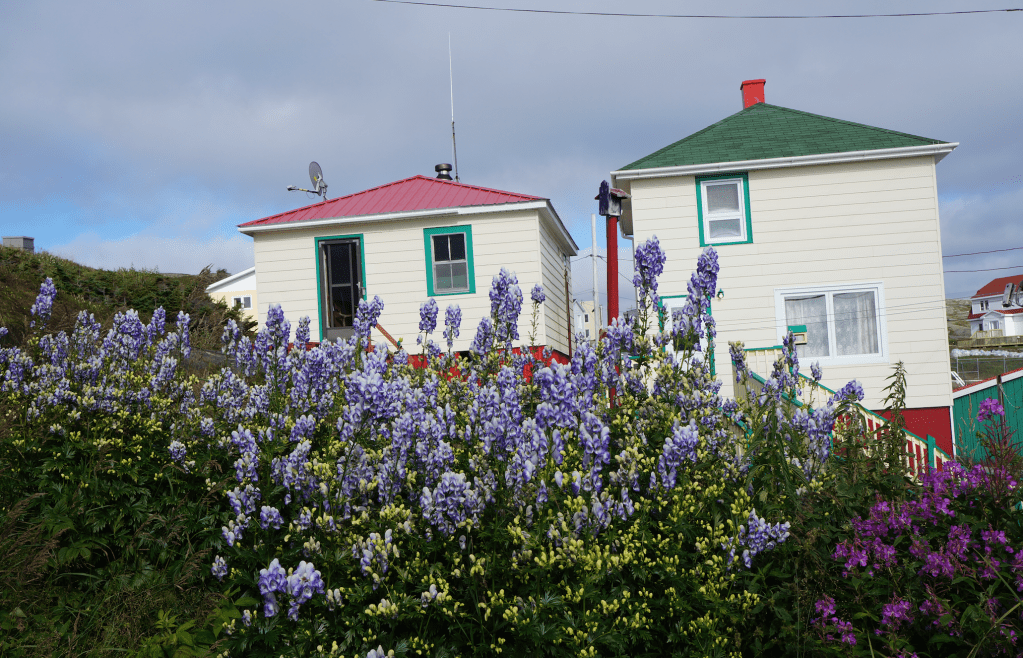
As we walked along the boardwalk, we admired the colorful houses, and the efforts made by the residents to build small gardens with flowers and vegetables. They have a short growing season and good fertile soil is hard to find. We spoke to a woman who was walking on the boardwalk with us. She told us that she has been born and raised in Harrington Harbour. She told us that she and her husband have two sons, one who is married and living in Edmonton. The other son is working in Montreal. When she found out we lived in Nanaimo, she laughed loudly and explained that her daughter in law was from Nanaimo! She also has two grandchildren.
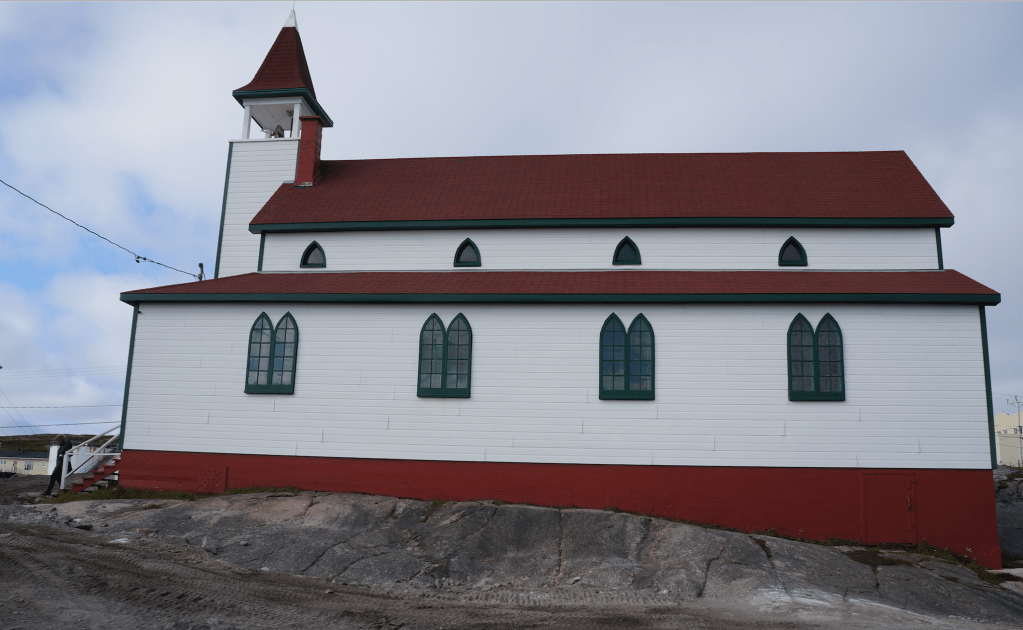
We continued walking and saw the church that had been used in the movie and the historic bell that was originally in the steeple of the Anglican Church that had burned down in the early 1980’s. The bell is now placed in a special place just to the side of the boardwalk. Further up the hill, were the welding and repair shop, the Harbourside bar, and the elementary school. Debbie and I marveled at how quaint and vibrant and active the community is. The main mode of transportation is ATV’s, which roar back and forth on the boardwalk. We met another man who was stacking wooden planks behind his house. He told us that because there is no wood or forest near Harrington Harbour, the wood is harvested by snowmobile inland in the winter and brought back to be used for firewood. He had developed a small mill and cut dimensional wood for construction projects for the community. He also revealed that one of his sons had returned to permanently work for the Village of Harrington Harbour.
We left the village after an enjoyable walk, feeling that we had just seen an idyllic way of life that had a strong sense of community. After seeing the movie last night it made our visit even that more special.
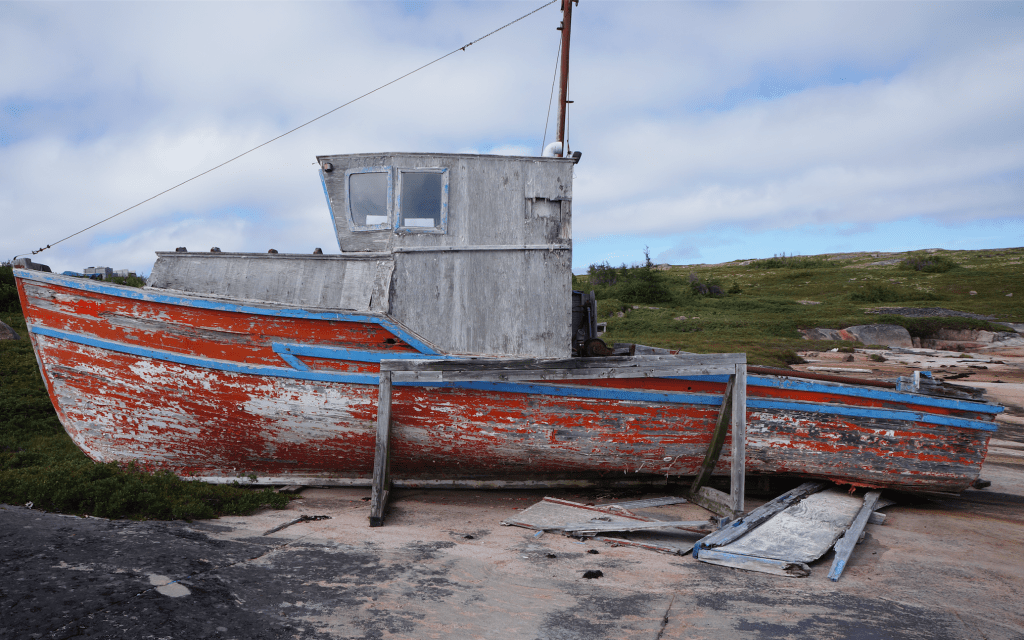
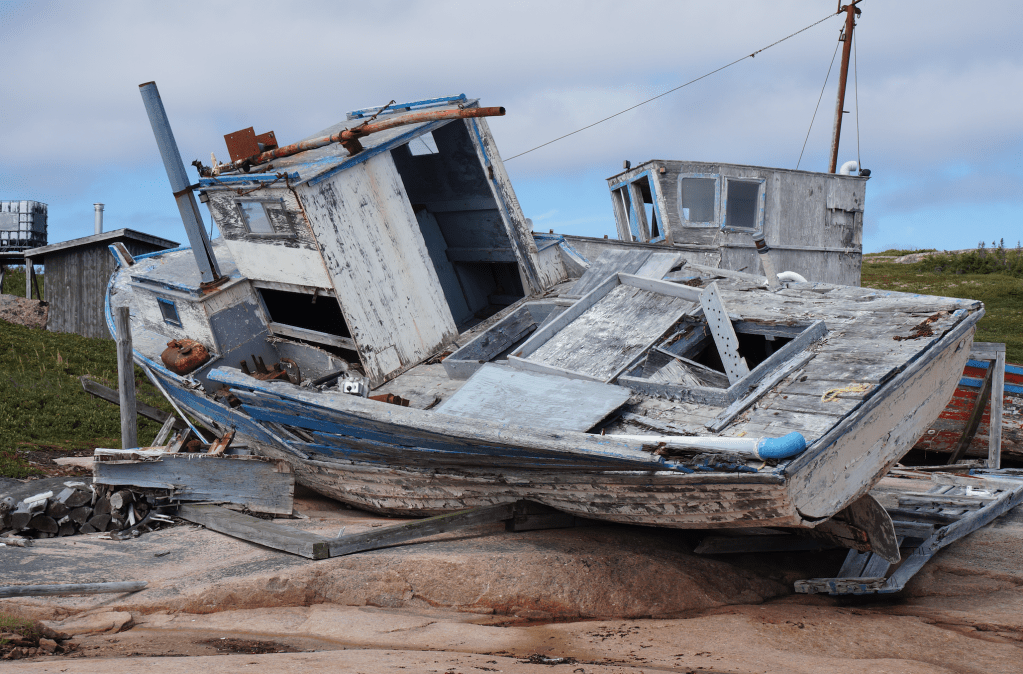
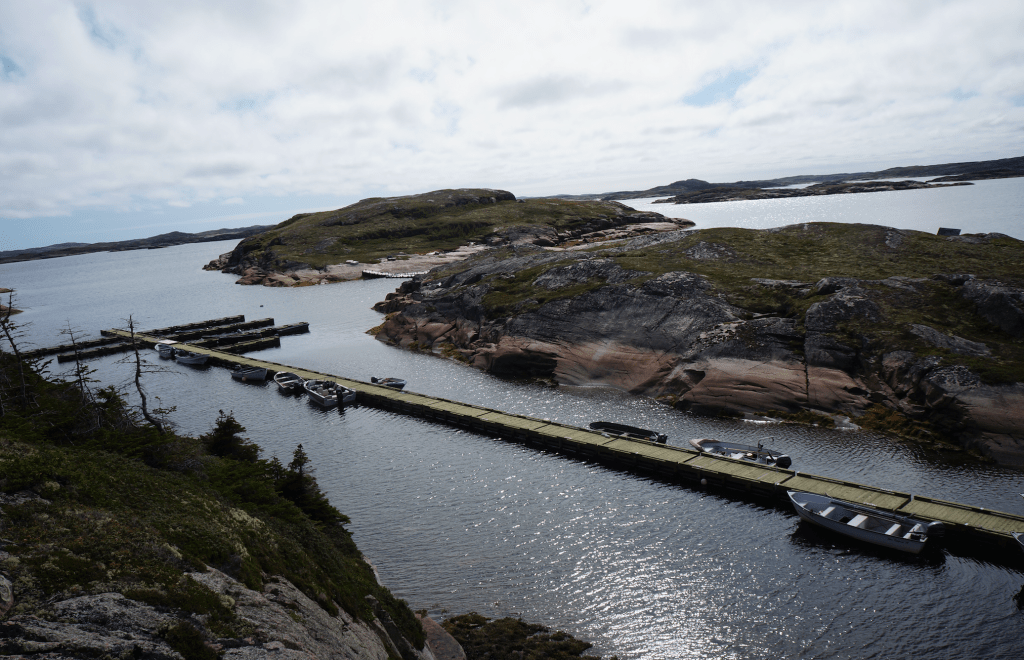
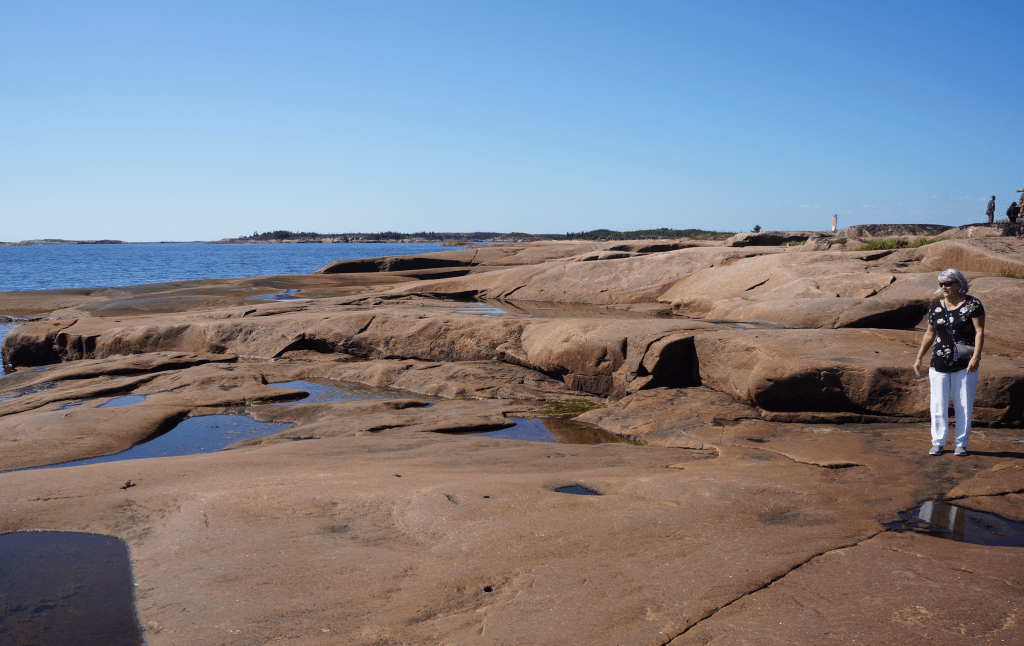
The next stop was Tete-a-la-Baleine. (pop 129) (Head of the whale). This town survives on the fishing industry. The harbor for this community is about a 25-minute drive to the village. We opted to walk on the shores near the harbor. The terrain has now turned into tundra like terrain with small melt ponds, large exposed areas of granite and low growing foliage. We walked around the remains of two abandoned fish boats left to deteriorate on the banks above the high tide line. They each had their own story to tell. We then clambered up to the highest point above the harbor and admired the scenery and the many small islets and channels all around the entrance to the harbor. Again we remarked how special this type of lifestyle must be, living in a harsh environment and dependent on each other in isolation.
In the lounge we met Jack and Christine, from Ottawa. They had boarded the Belle Degagnes in Havre-Saint-Pierre. During our conversation, Jack and I realized that we knew a mutual friend that I had trained with in 1969!
Our afternoon port of call was La Tabatiere, however, we arrived right at the time of our designated dinnertime. We watched as the ship left the docks and the small harbor disappear in the distance.
The evening ended with a Karaoke session in the lounge, most of the songs were in French but we enjoyed the efforts made by the many people that joined. It was a fun time.
Jack and I slipped outside on the viewing deck and watched as the skipper steered the ship through a series of very narrow channels to the Port of Saint Augustin. The shores of the islands appeared to be less than 50 feet from the ship. It was then time for bed as we were reaching the end of our journey and disembarking in Blanc Sablon tomorrow morning.
The alarm chased us out of bed at 4:00 am! It was time to go ashore, and it was still dark outside. We dressed for a hike and a boat ride, so it was a hurried trip to our meeting place on deck 4. Twenty-six of us early risers were going ashore. We left before breakfast, but Isabelle, the event co-ordinator, did provide a large bowl of fruit that we could take with us on the hike.
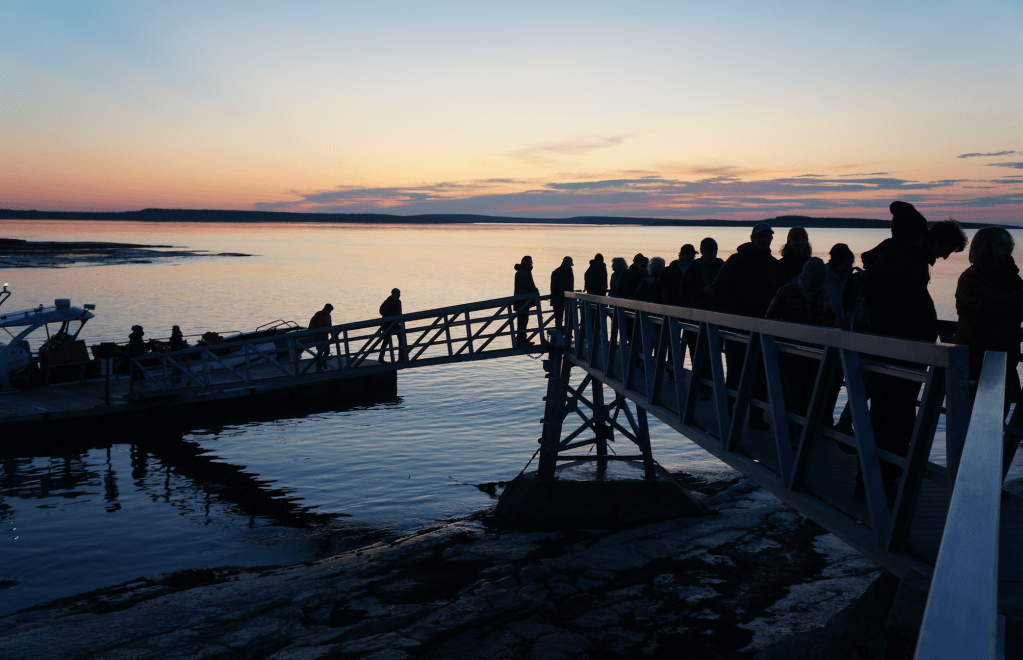
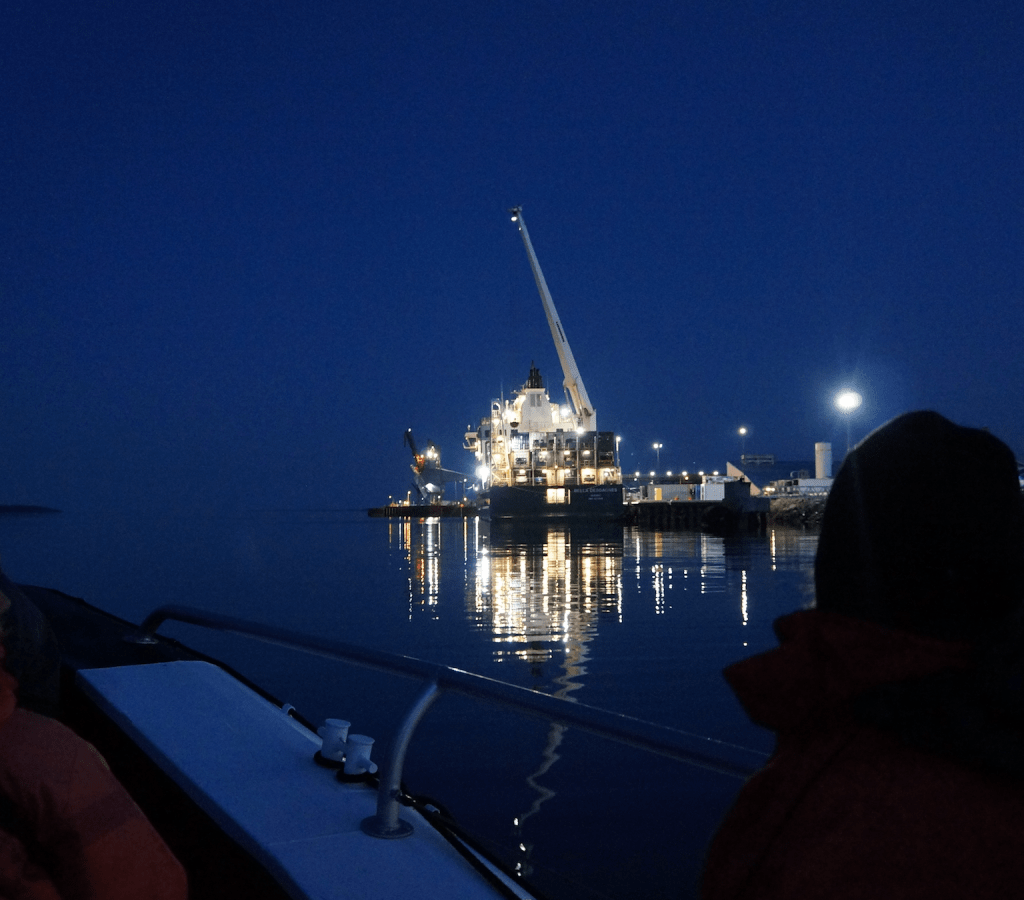
The ship was moored to the dock and was busy loading and unloading as we walked across the tarmac to the Parks Canada Interpretive Center. The Parks Canada staff welcomed us and handed out Mustang survival jackets and then escorted us to a large Zodiac. The sky was beginning to lighten and the buildings of Havre Saint Pierre were taking shape.
This community of 3400 people, is at the end of highway #138. This coastal highway was completed in 2017 and the town is feeling an upswing in tourism and visitors. It has a snug marina with many small pleasure craft and sailboats moored inside. The Parks Canada Interpretive Centre is at the entrance to the harbor and is a modern and well-appointed building. A large office building and a church steeple line the incoming street.
The water was mirror calm and the zodiac smoothly slipped across the surface. We had two Parks Canada employees as guides, one to speak French and one to speak English. As we passed by one island, the rock formations came into view and the sun was just coming over the horizon.
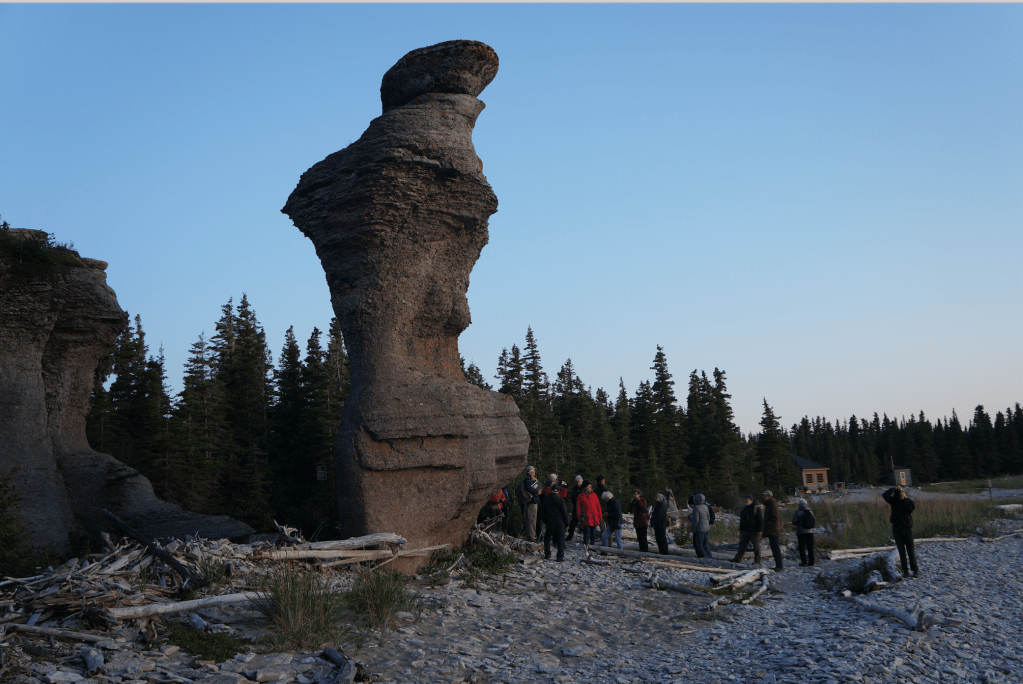
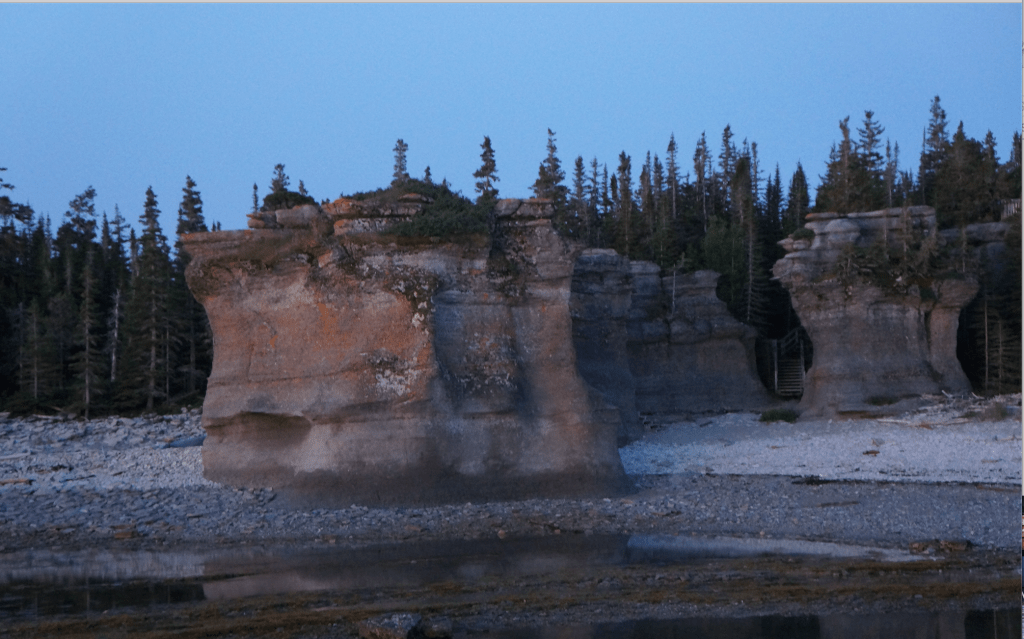
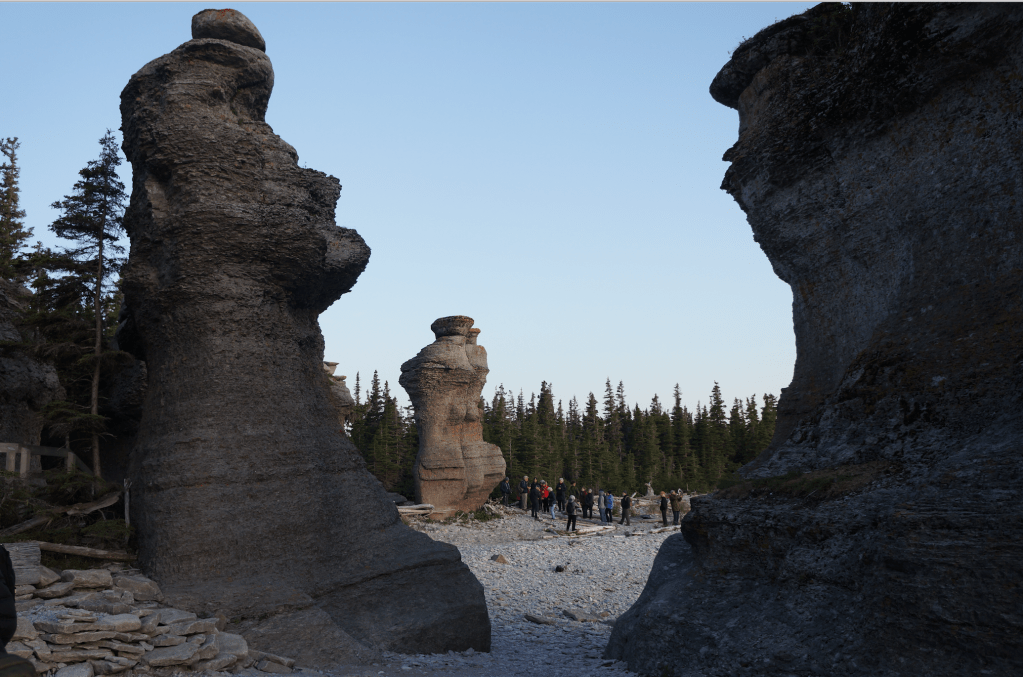
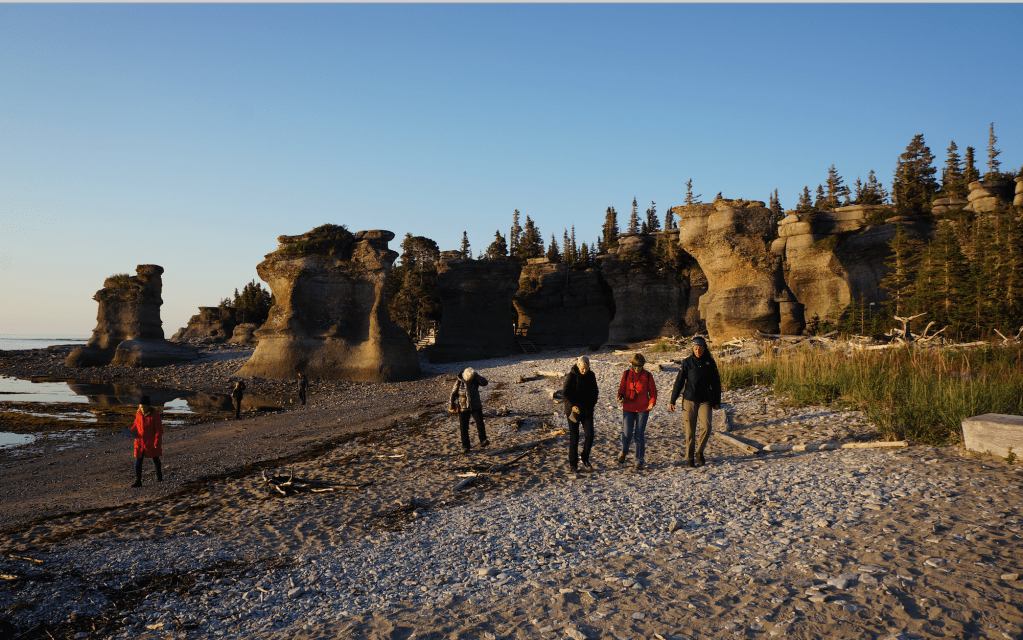
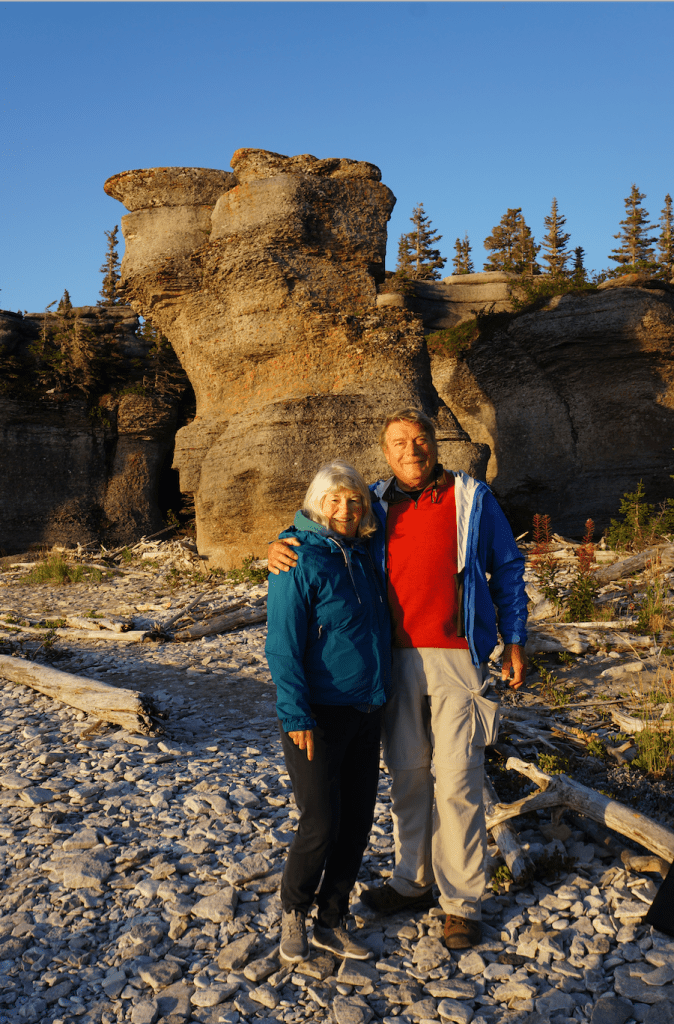
We docked at a Parks Canada dock that was connected by a well-maintained aluminum framed boardwalk onto the island. As we came onshore, the tall monoliths towered over us.
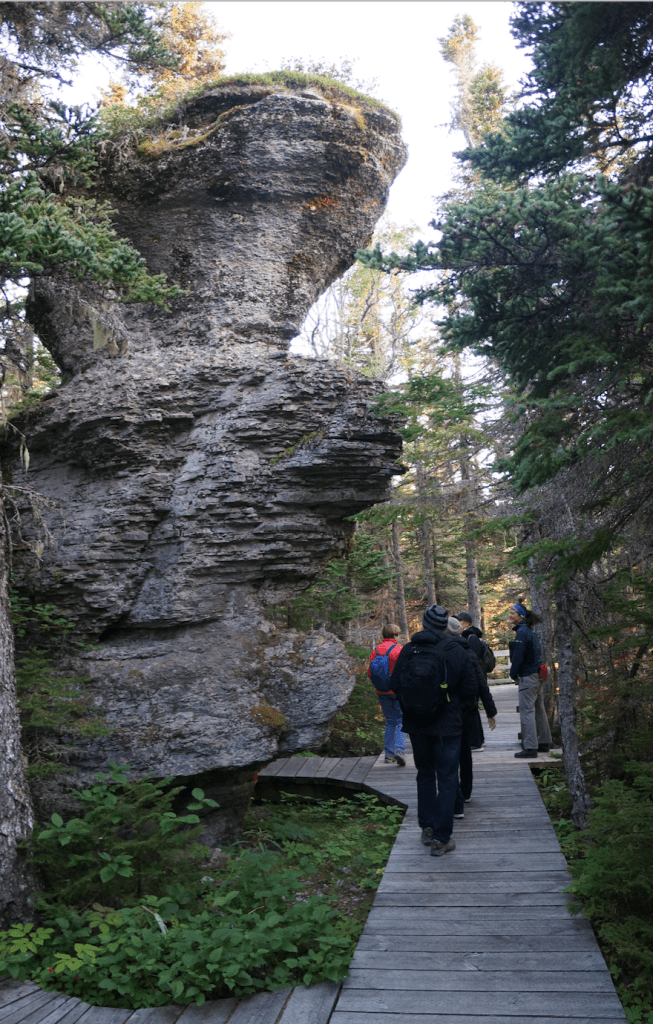
Our guide, took us, the English group, onto the shoreline and explained the historical development of the limestone formations on the islands. A boreal forest covers the whole area of the archipelago, and growing out through the forest are the monoliths. The formations are the results of the ice age receding, and water erosion, making them unique according to the various layers and the type of rock. Inside these limestone layers are many fossils that tell the story of the how the area islands were formed. We followed our guide through the boreal forest on board walks as she gave an informative narrative of everything we passed. It was a surreal sight to be walking through the boreal forests with the monoliths towering through the trees. The boreal forest was made up of black and white spruce, hemlock and tamarack, with thick growth of bushes and low growing plants. It was also a good experience for Debbie and I to be in the boreal forest as we had seen miles of it on our train trip to Churchill Manitoba, but we had not actually walked into it or studied it up close.
The entire experience on the island lasted about two and a half hours, (we had to get back to the boat), but we could have stayed in this area for days. It truly was a unique and memorable sight.
We returned to the Belle Desgagnes in time for another delicious breakfast. The meals served on this vessel are fantastic! Each meal has three choices; one is a chef’s choice. They are not huge meals but beautifully presented and well balanced.
After breakfast we went back to our cabin for a nap. Debbie slept well, however, I couldn’t so I came up to deck 6 and watched a presentation about the vessel and its crew, and history.
The Belle Desgagnes is the second supply ship of the Relais Nordik company and it replaced the Belle Nordik Express. The video showed the winter conditions that the personnel experienced in the winter months! To load this ship in -40 degrees or sail it in 60 mile an hour gales take a special person. The ship is the main supplier of goods to the lower north shore settlements and is an important part of the culture of the inhabitants to the settlements. Announcements on the public address system are made in French, English and Innu. The Canadian Coast Guard Icebreakers keep the channel open for the vessels until early January.
I then went into the cafeteria and worked on the blog. There is no internet service in this area, however, it was important to keep up with the notes as we have been so active each day on this ship. Debbie met me in the cafeteria as we missed the lunch meal in the dining room, however we enjoyed a light lunch.
At about 2:00 we arrived at Natashquan (pop 1100), another small settlement, whose main economy is based on tourism and mineral exploration. We walked through the community. This is the end of highway 138. There are no further roads north of this community. The inhabitants travel on the “white road” which is the snow and ice road from here to the other settlements in winter. The stop was about one hour and we wandered back to the community.
We had met Lucie and Jean on board the ship and they were watching their vehicle being lifted off of the ship. We had a couple of meals with them earlier on in the week, and we thought that they were leaving. We said goodbye to them and they started to laugh. They were actually leaving their vehicle in Natashquan, continuing the cruise up to Blanc Sablon and then returning to Natashquan to then drive the highway #138 back to their home in St. Croix, Quebec. Jean is going to the island of Anticosti to hunt deer.
Our next stop was Kegaska, a community of about 125 folks. We arrived just after our supper meal. We had met Denise and Paulette for breakfast yesterday and they too were going for a walk so we joined them for a short walk into the community. It was Paulette’s birthday so we wished her Happy Birthday. The ship finished unloading early and was ready to go before our re-boarding time. We hurried up the gangplank and thankfully just made it on time!
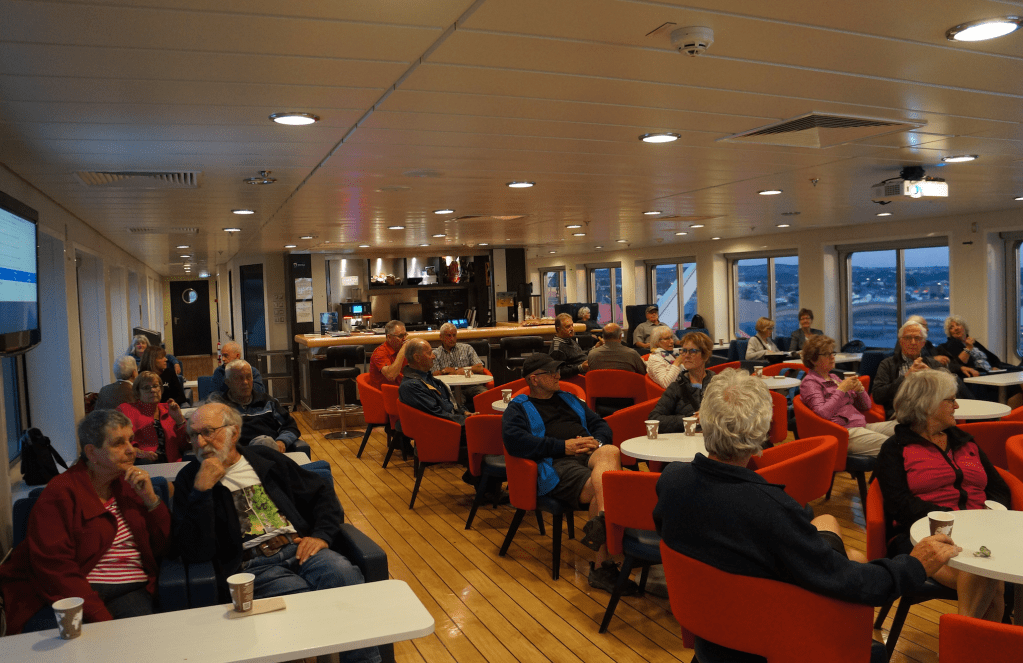
Tomorrow morning, our first port of call will be the community of Harrington Harbour. This village became famous with the on site filming of “Seducing Dr. Lewis”. Tonight we are going to watch the film in the lounge on Deck 8. At about 8:00 the lounge began to fill and by show time all the seats were filled. Judging by the laughter and the applause at the end, it was evident it was enjoyed by everyone. We then went to bed, looking forward to another day of new places and sights.
Our designated breakfast time is 7:00 so we were out of bed and getting dressed by 6:30. There are two meal times for each meal and we had been assigned the early times 7:00, 11:30, and 5:00.
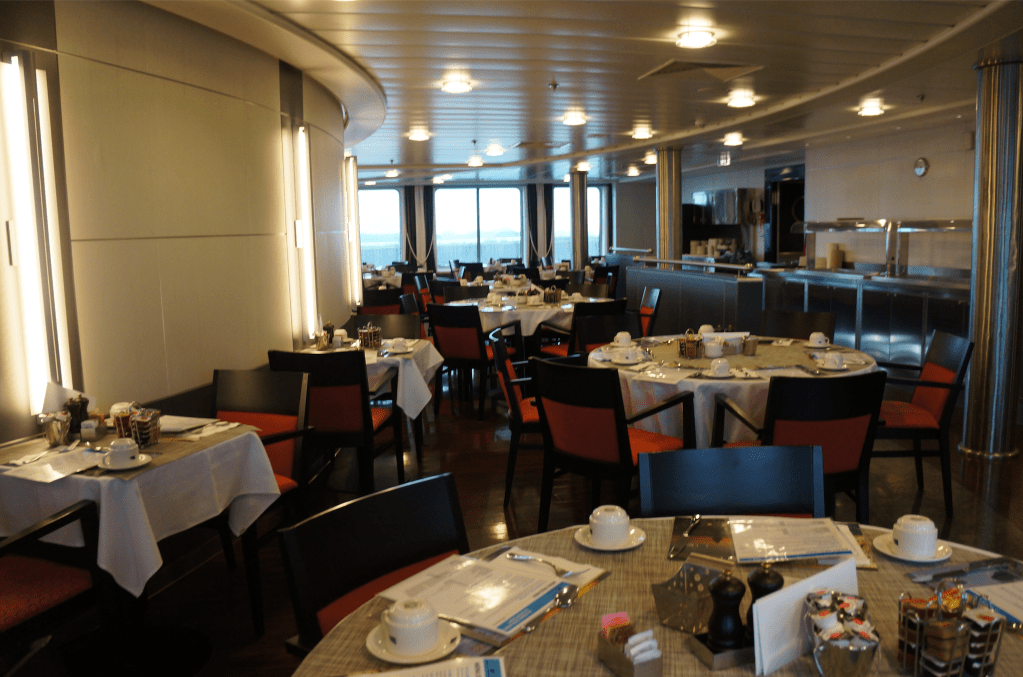
Breakfast is served in the dining room and the maitre’ de, attempts to mix the groups so each time you sit you eat with a different couple. This method certainly encourages you to learn different words in French/English.
After breakfast we sat in the main lounge and talked to various people and couples, some bilingual, some not. The majority of the present passengers were making a round-trip of this tour going to Blanc-Sablon and then returning. There was a variety of types of trips that people were taking. Some were going on to visit places in Labrador. Others were disembarking at the settlements on the lower north shore and driving back south on highway 138. (Others were coming on board from the settlements and travelling to other settlements.) There were only a few of us that were leaving the ship in Blanc Sablon and crossing to Newfoundland.
The weather was warm with no winds and the water was flat. Our first port of call was to be Port Menier on Anticosti Island. We would be arriving at 5:00pm. At 11:45am we all met in the main salon on deck 5 to receive the mandatory safety drill, learned where our muster stations were and the use of the lifeboats and floatation equipment.(“In the unlikely event…”).
The events coordinator, Isabella, showed us a short documentary on the development and life on Anticosti Island.
This island is in the middle of the St. Lawrence River. The island is 222 kms long and Port Menier is the only settlement on the island. (pop. 205). The history of the island is that Henri Menier, a rich French chocolate maker, in the late 1800s, purchased island. Menier wanted to make this his personal island, (he only visited it six times), but developed a small community on the island. He introduced several species of other animals onto the island, some survived to thrive and some didn’t. Red and silver fox, ruffled grouse, and white tail deer survived. The estimated deer population on this island is about 160,000! At present the main industry is logging however the tourist industry is growing with based on recreational hunting and fishing activities. Because of the diverse climate and uniqueness of the island and its natural beauty, it has been declared a UNISECO heritage site and plans are under way to assist the island in developing its reputation as such.
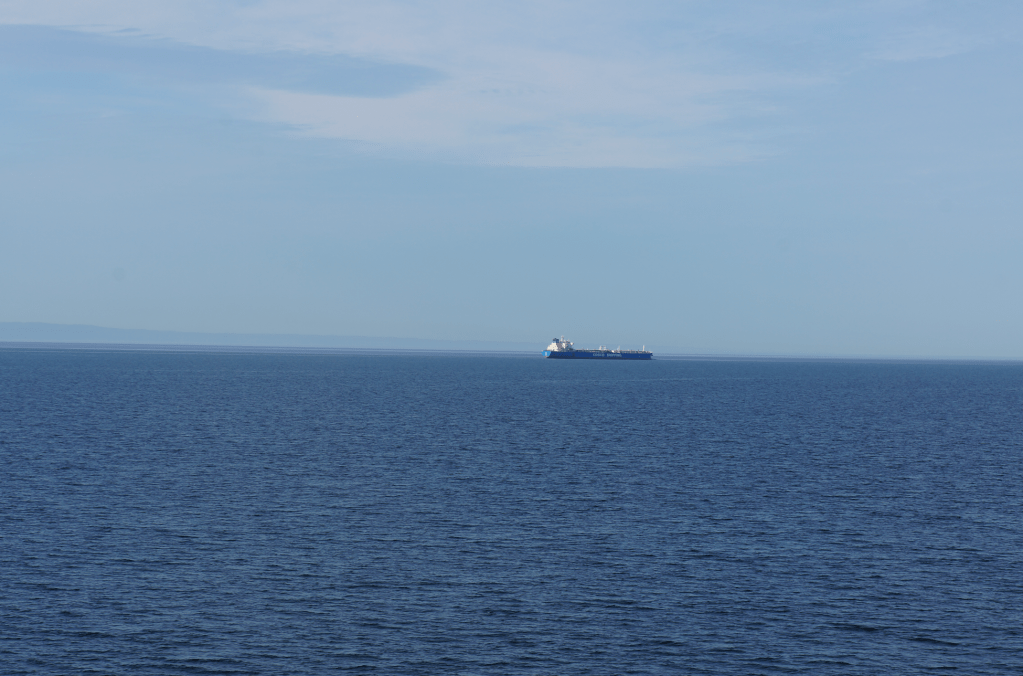
We cruised upstream towards, Anticosti Island, occasionally seeing whale spoutings. This area near the western tip of the island is heavily populated with whales and the speed of 10 knots has been enforced for ships passing through this area. Belle Desgagnes reduced her speed and we sat on the outer decks scanning the waters for whales and watching as Port Menier appeared on the horizon. (We learned later that entering the harbor of Port Menier we had only 30 cm’s of water below the ship!)
Two groups of passengers had expressed an interest to go ashore and visit the small community, including us. We hopped aboard a local shuttle van that took us the one and half kilometers into Port Menier.
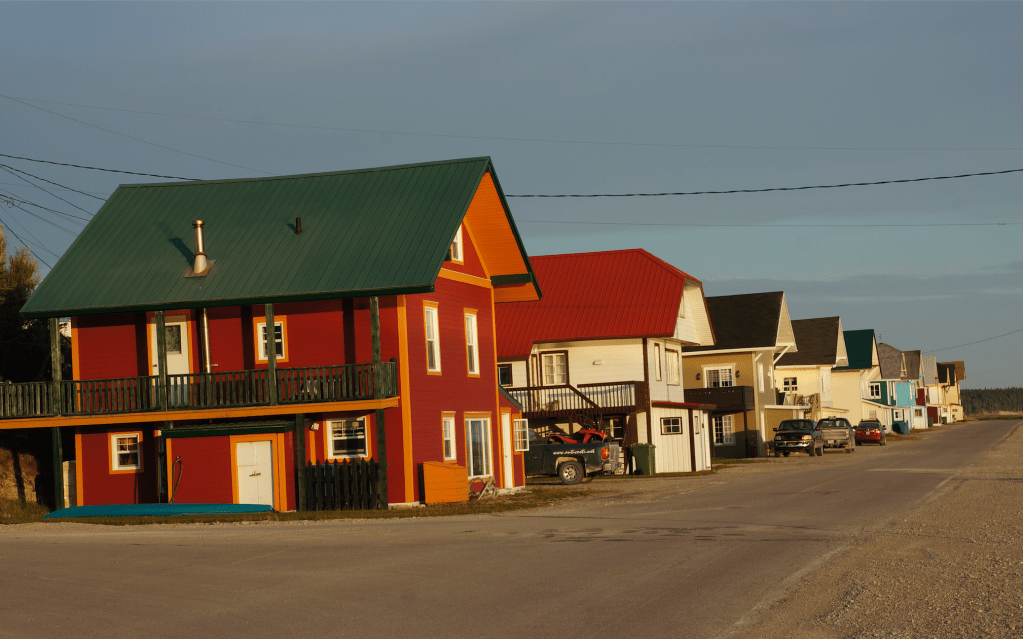
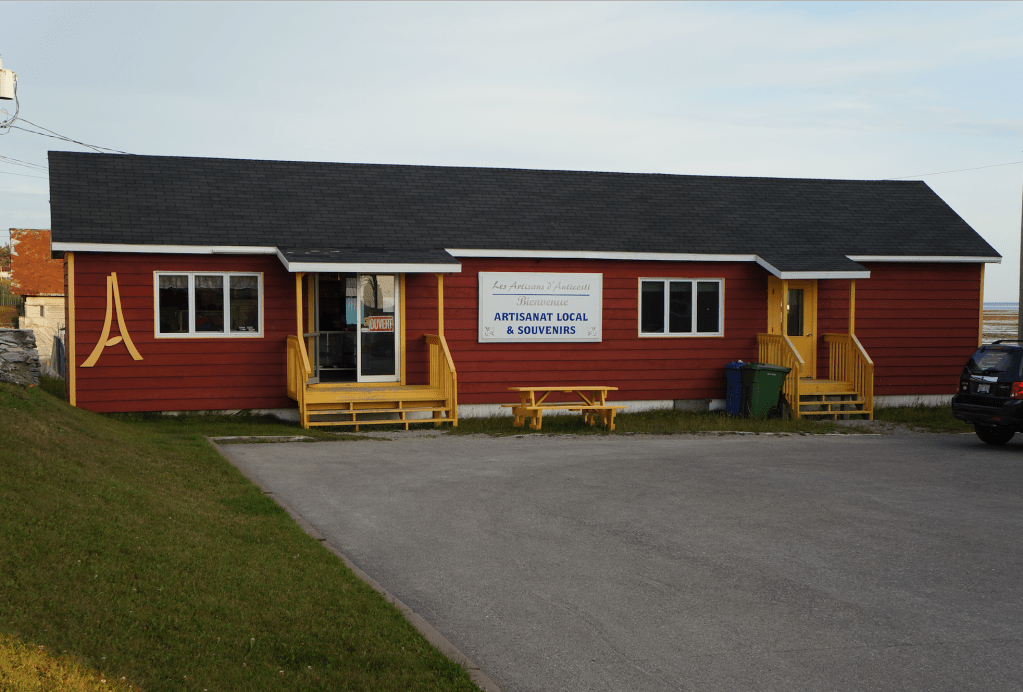
The community is situated along the shoreline and the brightly painted houses line main-street. The homes were constructed in 1910 and are still lived in and well maintained. Near the church (which also serves as the museum) is a small bungalow that sells souvenirs and local artisan crafts. Deer are quietly grazing on the grass and simply look up as you pass by. They are everywhere. Dogs are not allowed on the island. Debbie and I walked around the community for the hour allotted to us and then walked back on the quay to the ship. It was still busy loading and unloading when we returned, but left port shortly after.
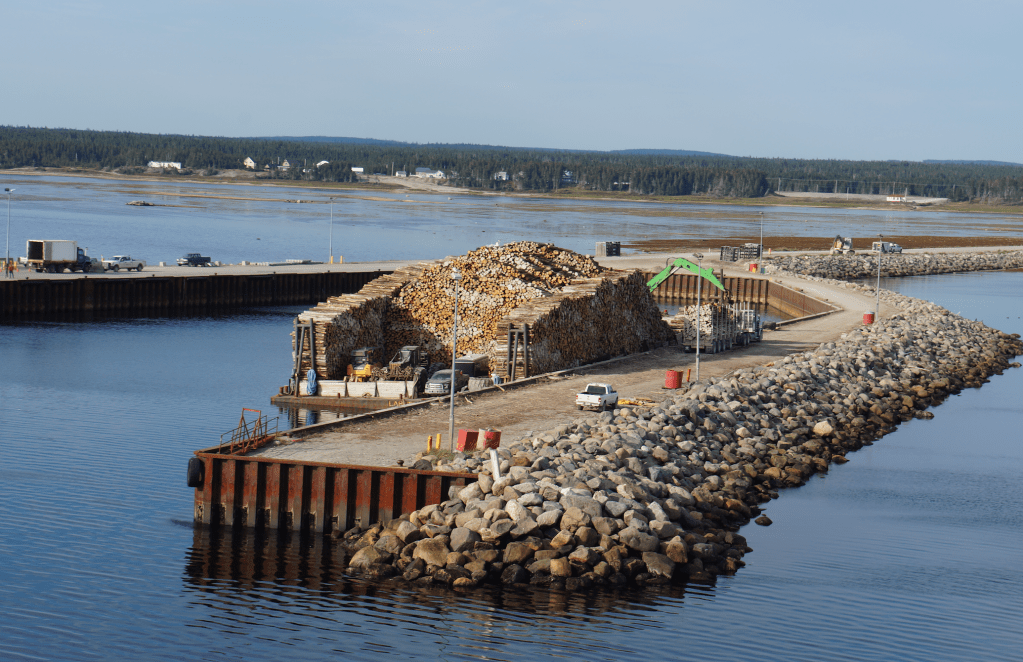
On the opposite side of the dock, a large barge was being loaded with logs. Heavily loaded logging trucks, backed alongside the barge and a small crane lifted the logs in bunches onto the barge. The pre cut logs are about five feet in length and neatly stacked on board. The barge was almost full. I learned that two of theses barges leave Anticosti Island each week, for Rimouski. As the sun was setting we steamed away for our next port of call Havre-Saint Pierre.
Before we went to bed, we watched a series of small documentaries about each of the communities that we would be visiting this week. We had signed ourselves up for an onshore excursion to the Mingan Archipelago National Park Reserve, a Parks Canada National Park, which has unique rock formations and reportedly a “must see” visit. We would be disembarking the ship at 4:20 am! It was time to go to bed!
We are now leaving Quebec City to travel to Rimouski, a small city half way up the western shores of the Gaspe Peninsula. We are meeting our cargo/passenger ship there to place our rig onboard and take a cruise along the “lower north shore” of the Gulf of St. Lawrence. We would be disembarking in the last port of call, Blanc Sablon, and taking the ferry across to the Newfoundland Peninsula.
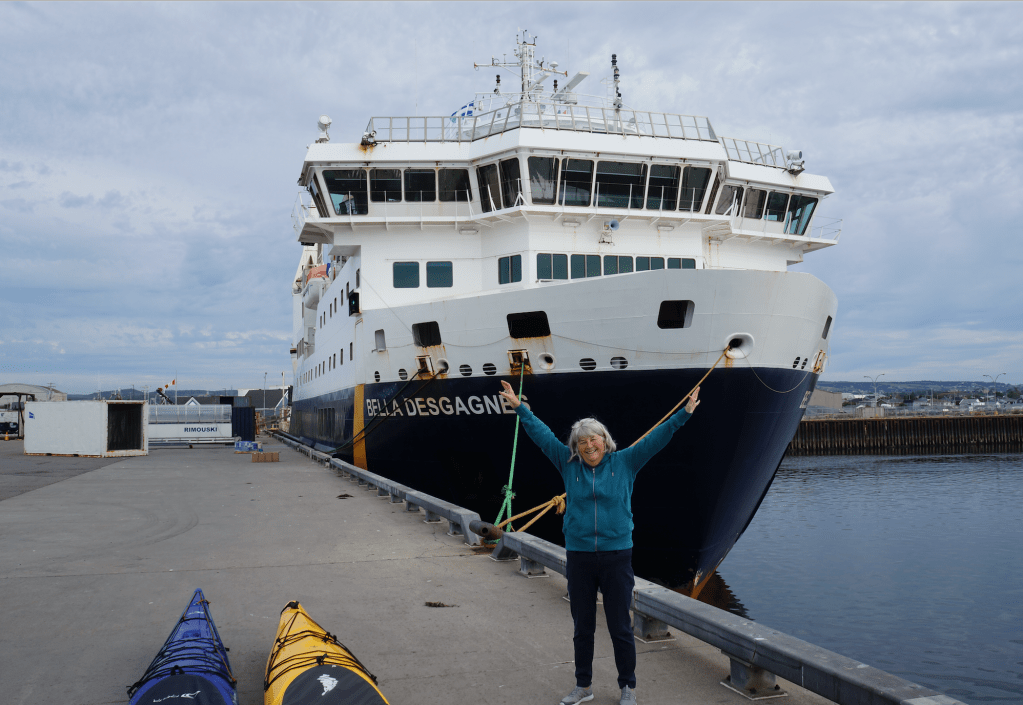
We have reserved a berth on a vessel called the “Bella Desgagnes”, a cargo/passenger supply ship that takes weekly trips to settlements on the “lower north shore”. The company is called Relais Nordik Inc. The Belle Desgagnes was built in 2013 and the company has been provisioning the settlements for many years. There are only about ten cargo/passenger ships in the world designed in this fashion. The ship is specifically designed to navigate to the various ports of call. It operates for seven months until the weather and ice forces it to stop. It is 97 meters in length and 19 meters wide and has a draft of 4.50 meters. The loading crane’s boom is 35 meters in length and is capable of lifting 40 metric tonnes. The ship has berths for 106 passengers, however, can transport approximately 381 passengers, many who travel weekly between the settlements. The ship is their only means of transportation during the summer months. It has a crew of 39 hard working employees.
We had to be in Rimouski by 5:00pm in order for the longshoremen to inspect our trailer and car, remove the kayaks and the kayak rack, and ready the rig to be put into containers.
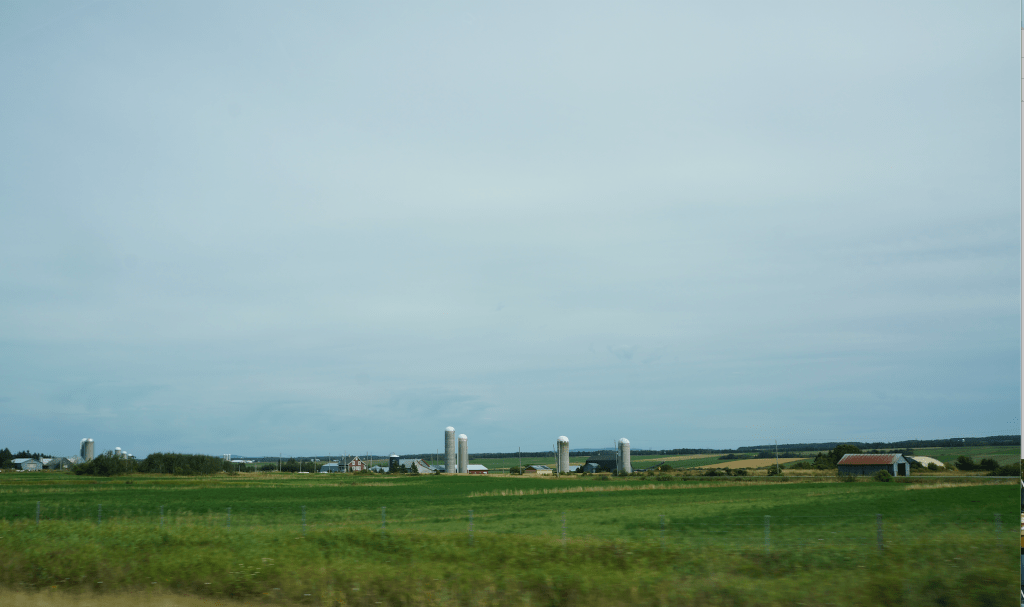
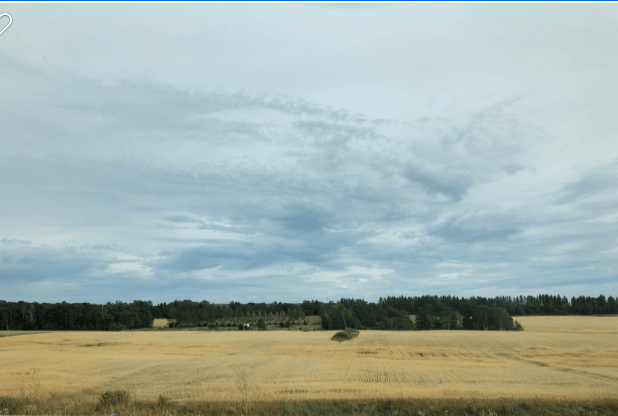
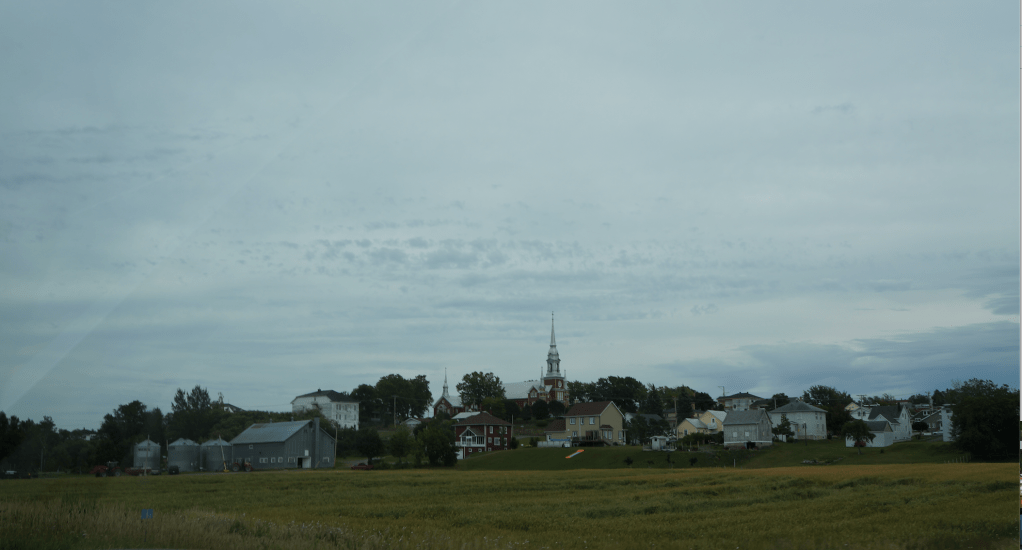
We were on the road by 10:30, and Debbie and Miss Taken navigated us through the web of roads of Quebec City and onto Hwy #20/132. (It appears that every road in Quebec is under construction!) Although this highway is a major highway, as we traveled north it becomes less busy. On your left is the St. Lawrence, ever widening, with the Laurentin mountains in the background and on your right are large farms, with wheat and fields of corn interspersed with forests. The rolling hills make this a beautiful landscape.
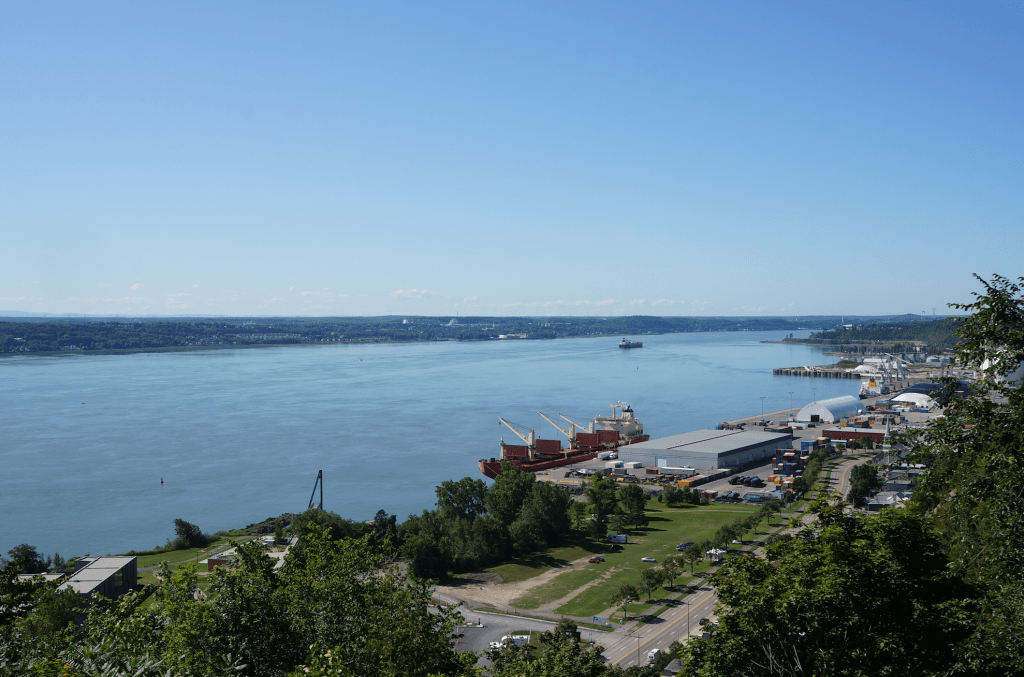
With the occasional stop for a Tim Horton’s latte, we arrived in Rimouski at 4:30pm. As we descended into the city we could see the ship moored at the docks, it huge crane reaching up in the sky. We pulled into the docks and met with a traffic controller who had to ask another man to give us directions in English as to where to park and disassemble.
The loading was not to start until 6:00 so that gave us lots of time to remove the kayaks and the kayak racks off of the truck. We had packed our personal belongings that we needed in our tote bags so we were ready to board by 5:30. We sat in the trailer and ate our meats and vegetables and fruits that we could not take on board. Because of the late boarding we would not be having dinner onboard, so this was a perfect time to consume any perishables before locking the trailer for the next five days.
The loadmaster arrived and between our broken French and his broken English we managed to communicate the necessary information. We left the keys for the truck with him, he inspected the truck and trailer and kayaks to document their present condition, and told us how they would be loaded. We checked into a small kiosk on the docks and were directed onto the ship.
We were assigned our reserved cabin and told that our luggage would be put into our room. We were allowed to wander on the various passenger decks. I stood on the outside decks taking photos of the setting sun, the city of Rimouski and of our possessions spread out on the docks.
At 8:30, we were directed to the salon on deck 8 for a welcome/introductory session. The English-speaking passengers went to a conference room and were given the same session in English. I was impressed that the CEO of the company, who mingled with all of us before and after the session, gave this session. He was fluent bilingual and made an effort to speak to each of us individually.
They explained the various ports of call that we could expect and what type of settlements and peoples we would meet. We were given a log book, that explained each port of call, points of interests, expected time ashore and when to re-board. The dining room seating times and procedures were given out and explained. There is a cafeteria onboard as well as a lounge, exercise room and theater.
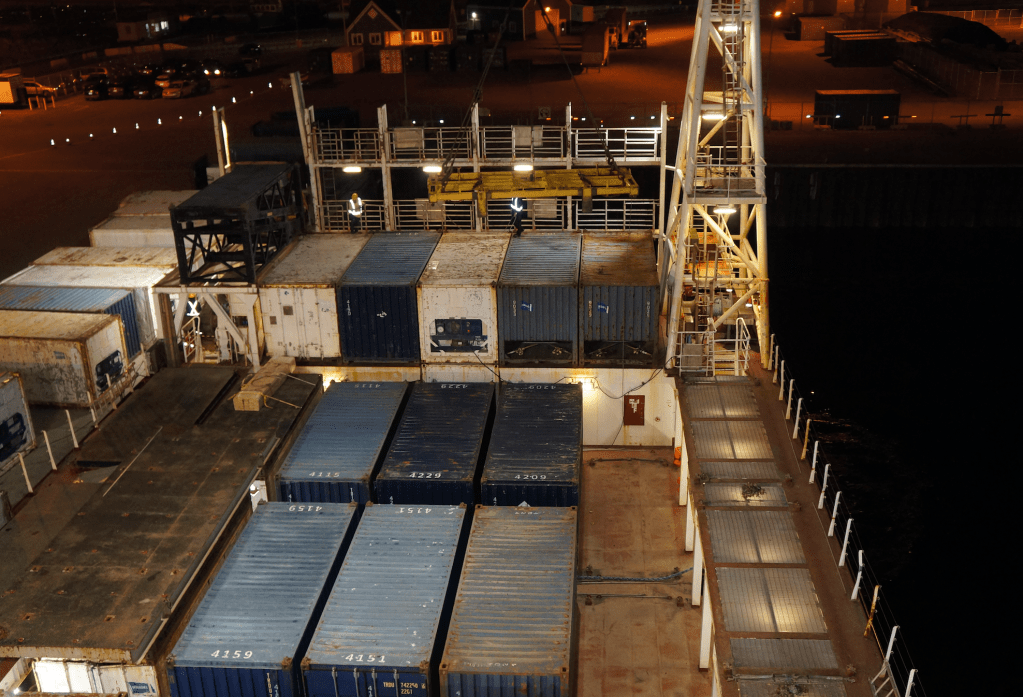
Spread along one side of the ship, on the dock, was a series of empty containers open on each end. As the passengers and their cars arrived, the vehicles were inspected and the loadmaster would slowly drive them into a waiting container. The men would then tie the axles down onto the container. Our little trailer was attached to a forklift and maneuvered into a separate container. Somewhere during the evening our kayaks were loaded, however, at 10:30 they were still sitting on the dock. We watched the loading procedure, Debbie left early, and I watched until 11:20.
The huge onboard crane would pick each container off the docks and swing it onboard into a designated spot on the rear deck. A crew of 8-10 longshoremen worked steadily as the crane swung the lifting cradle to the docks, attaching the containers and then directing the cradle to the proper placement on deck. All types of cargo was loaded, ranging from roof trusses, crates of building materials, all of the vehicles of the passengers like us, and heavy construction machinery. Two large wooden hydro poles estimated to be over 80 ft. long were tied on the port side gunwales on the outside of the ship. I was wondering when and where the container holding our trailer was going to be stowed but it was still sitting on the docks when I went to bed. (I later found it while walking on shore at a port of call. Both containers were tucked away in the far port side corner at the very rear of the ship.)
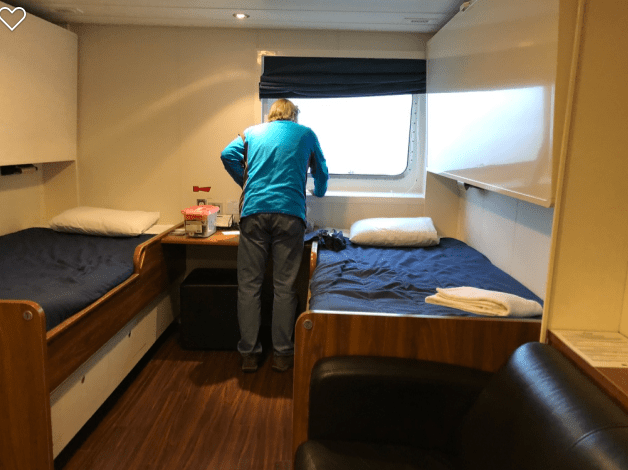
Our cabin is situated on deck 5. It is spacious with two wide single beds, a washroom and shower, a small settee and several closets and a small desk. I commented to Debbie that this cabin was larger than the cabin that we had on our last Caribbean cruise.
As I lay in bed I could feel the ship list slightly as the crane picked up a heavy object and swing it onboard. I fell into a restless sleep, and awoke around 2:30 to find the ship underway. What will tomorrow bring?
We wanted to see more of Quebec City today and Debbie wanted to go to the Laurier Quebec Shopping district to complete her quest in finding clothes. We agreed to part ways for most of the day and meet later in the afternoon.
We both bought tickets for the Hop On Hop On bus, she was taking one bus to her shopping district and I was taking the tour and getting on and off at the various places in the City.
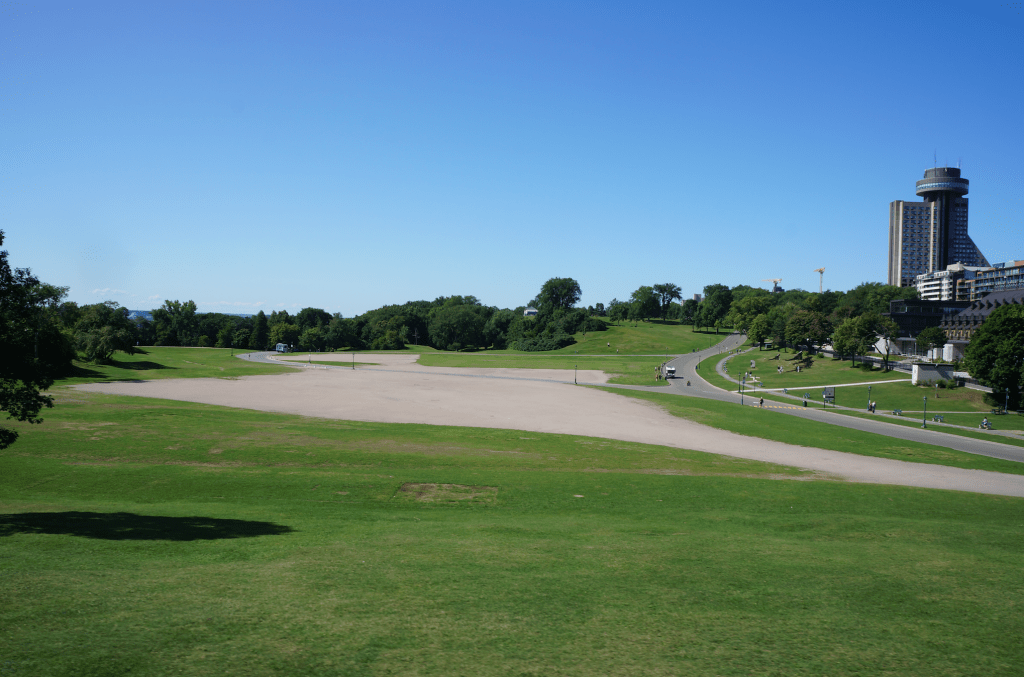
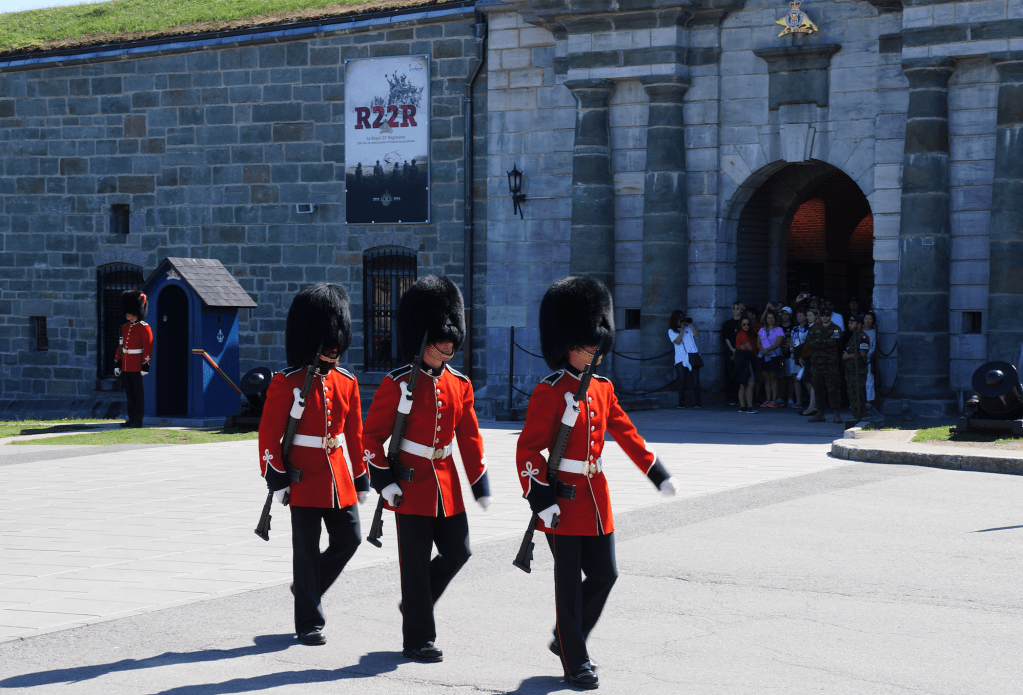
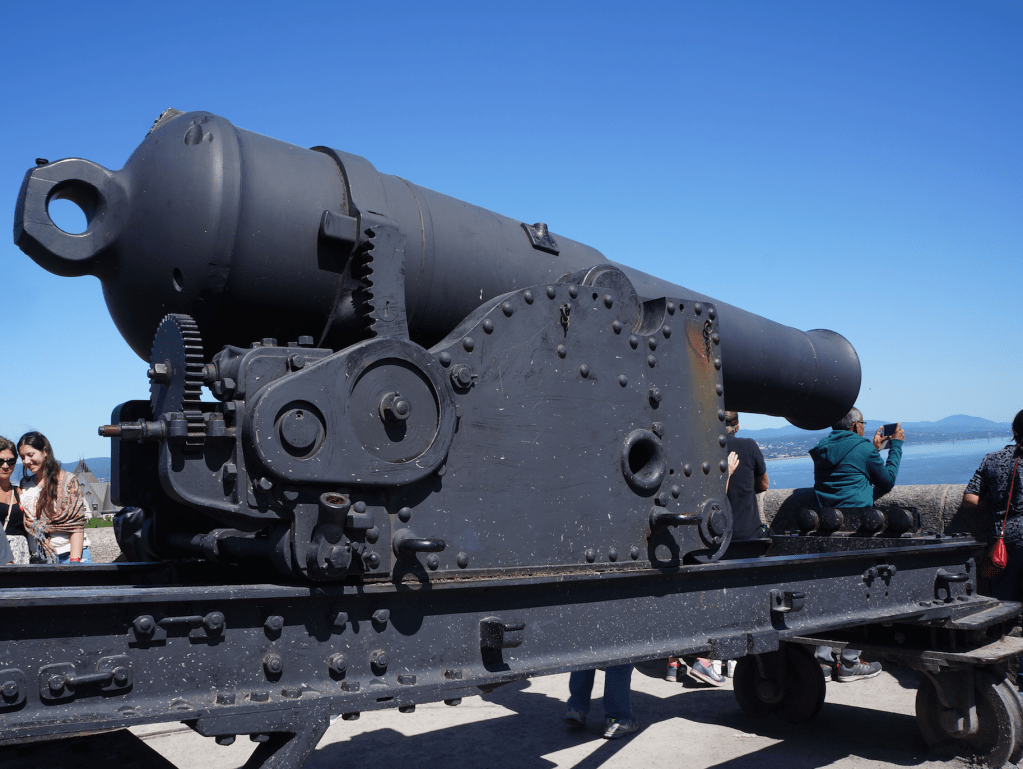
The first stop for me was at the Plains of Abraham and the Citadel. The Plains of Abraham has now become a National Historic Site and encompasses 250 acres. The Citadel is the operational base for the Royal 22ndRegiment and houses the Museum, and conducts tours of the military base. I arrived just as the sentries were being changed. Once inside the base, we were given a one-hour tour of the base. The guide showed us the various buildings and structures that had been built in the late 1700’s and how the fort grew over the years after the battles with the American soldiers in the war of 1812.
The completion of the fort was done by the British to prevent further attempts to take over this important base. Quebec was the first North American fort, built strategically on the eastern coast to protect Canada. All trade and commerce had to go past Quebec on the Saint Lawrence River to enter the Great Lakes and have to access the Mississippi and Hudson Rivers.
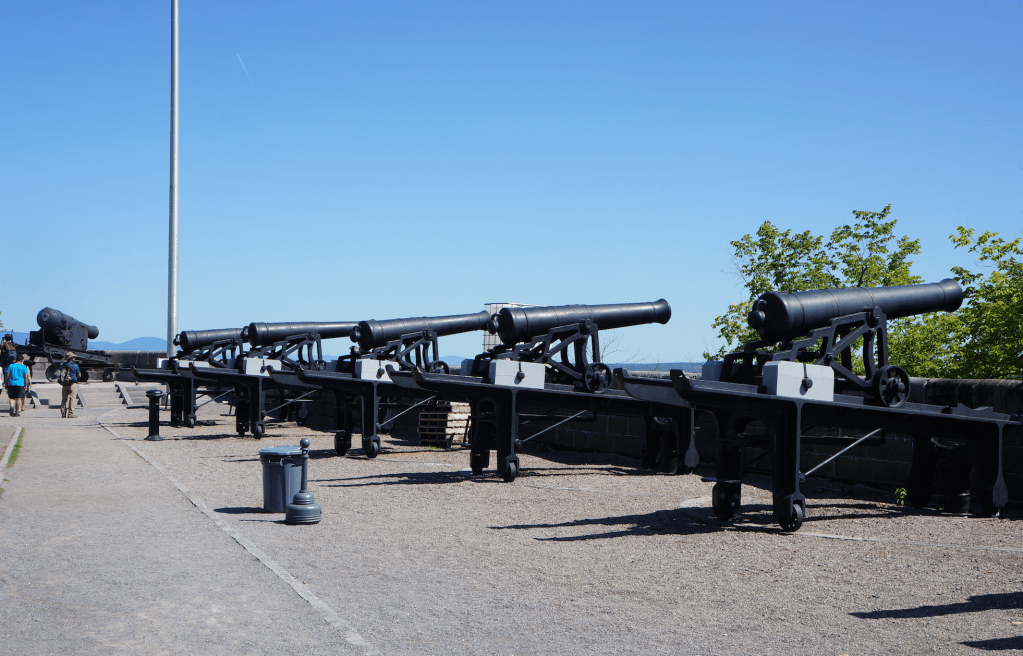
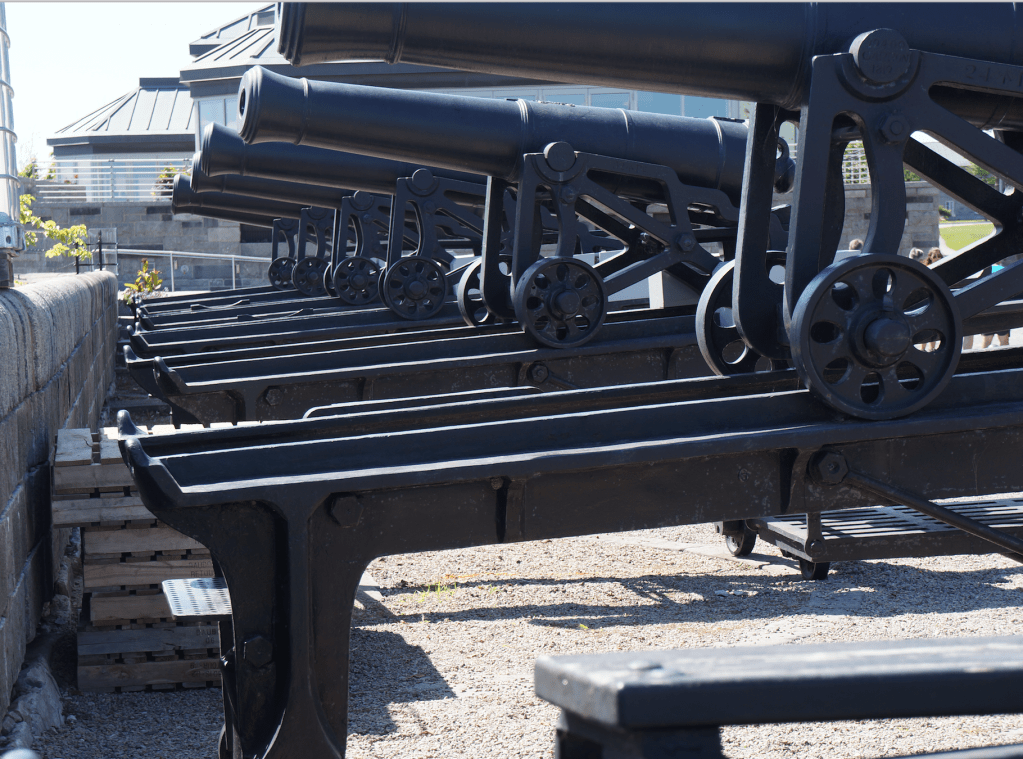
The guide showed us the cannon placements and pointed out “Racheal” the largest cannon able to launch an 80-pound explosive cannon ball three kilometers. It had never been fired.
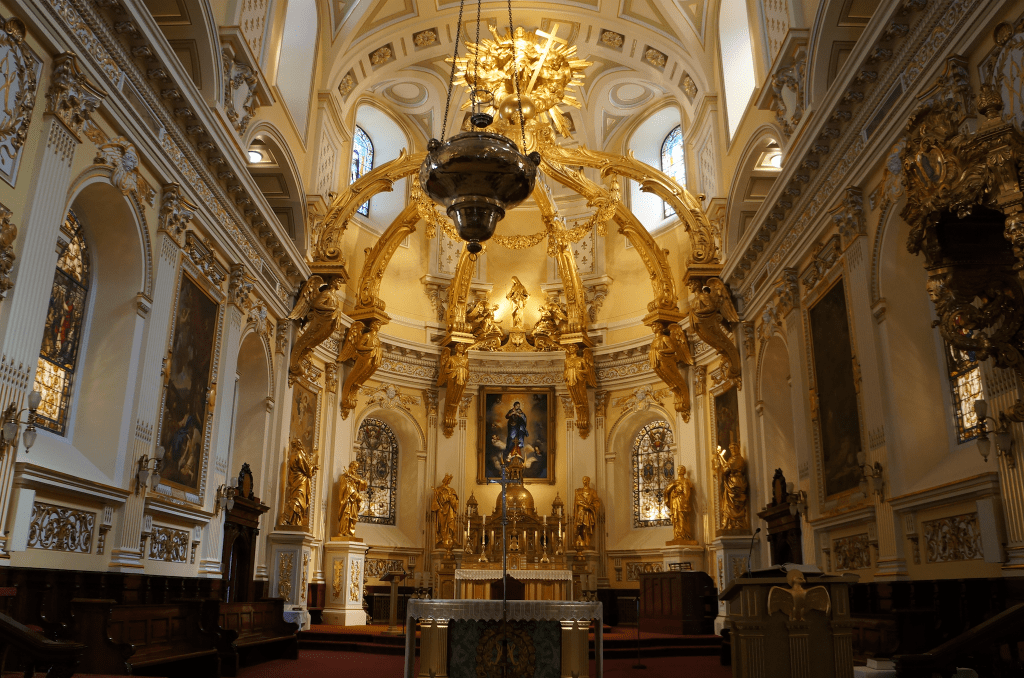
My tour continued through the city and I hopped off at various sites, including the Notre Dame Cathedral. Debbie had finished her shipping spree and was returning to the Old Quarter.
We met in a small bistro near the Frontenac Hotel and enjoyed a late lunch/early supper of crepes, which each of us shared our choices. She proudly told me of her purchases and I related my stories and sights that I had seen. We enjoyed the music of a guitar player who sang both English and French songs.
We toasted Quebec again and then took the shuttle back to the trailer. We decided to cook and barbeque what little food we had left in the fridge as tomorrow we would be driving to Rimouski to put the trailer and truck onto the cargo ship and into containers. We would be eating this food before we board so as not to have it spoil on the journey on the ship. Then it was off to bed.
Today is packing up day as we are heading for Quebec city. Debbie was able to do laundry before we packed so that set us up for the trip ahead. We set up Miss Taken to get us around Montreal. We have visited Montreal before, and were not keen on dragging the trailer through the city. Our drive to Quebec City was about five and a half hours. Debbie had reserved a commercial campground in Quebec and we wanted to be there before 8:00pm. The drive this time was on major toll highways, but Debbie and Miss Taken navigated through the many bypasses and overpasses to get us safely to Quebec. We arrived at the Camping du La Jolie campground at 7:30pm.
We set up our camp and then sat in the dark looking at the stars and relaxing from our drive. Debbie made soup and we enjoyed a bowl until we were too tired to stay up any longer and went to bed.
Aug 24, 2019
We are taking the campground shuttle to the city of Quebec City today. We wanted to do a few things such as blogging, and decided to take the 1:00 pm shuttle in. We packed some sweaters and water and things in a backpack and walked down to the main office.
This is a huge commercial campground that had a mixture of permanent residents, some seasonal campers and then us campers, who are short term. Our campsite is about a 5-minute walk from the campground entrance. It is secluded with trees and bush surrounding us. The campground is about 20 minutes from the Old Quebec city. The shuttle is taking us right to the front door of the famous Frontenac Hotel.
Prior to us leaving we learned that the finale for the annual fireworks display was on tonight. Our shuttle would not be available to pick us up late after the fireworks. We had just met Dave and Carly from Portland, Oregon. They too were wanting to see the fireworks, so we agreed to share an Uber ride back to the campground after the fireworks.
Dave and Carly are both recently retired and are travelling across the continent in a van conversion motorhome. Their campsite was three over from ours. They have travelled across the northern States, came into Canada, leaving Quebec for Nova Scotia, then back down into the States. They will be travelling for a year before they return home!
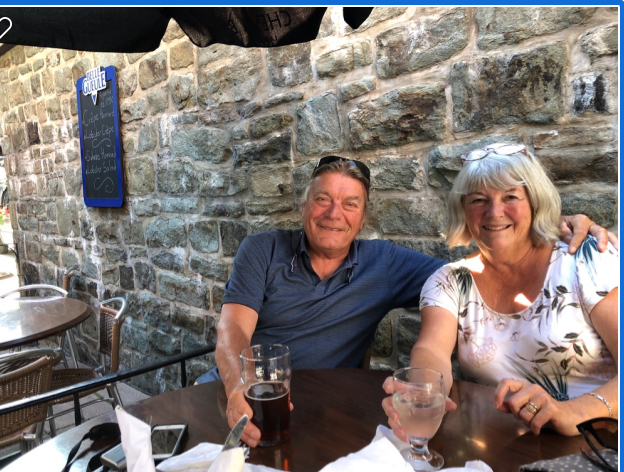
Because we only had the afternoon, we decided to just explore the old quarter on foot and take the Hop on Hop off bus tomorrow. Debbie had planned for a long time to shop for some clothes and things and so we decided to walk the many streets and check out the shops. After visiting the tourist information center we had a quick hamburger and beers. That bill for two burgers, two beers ended up costing $82.00!!!
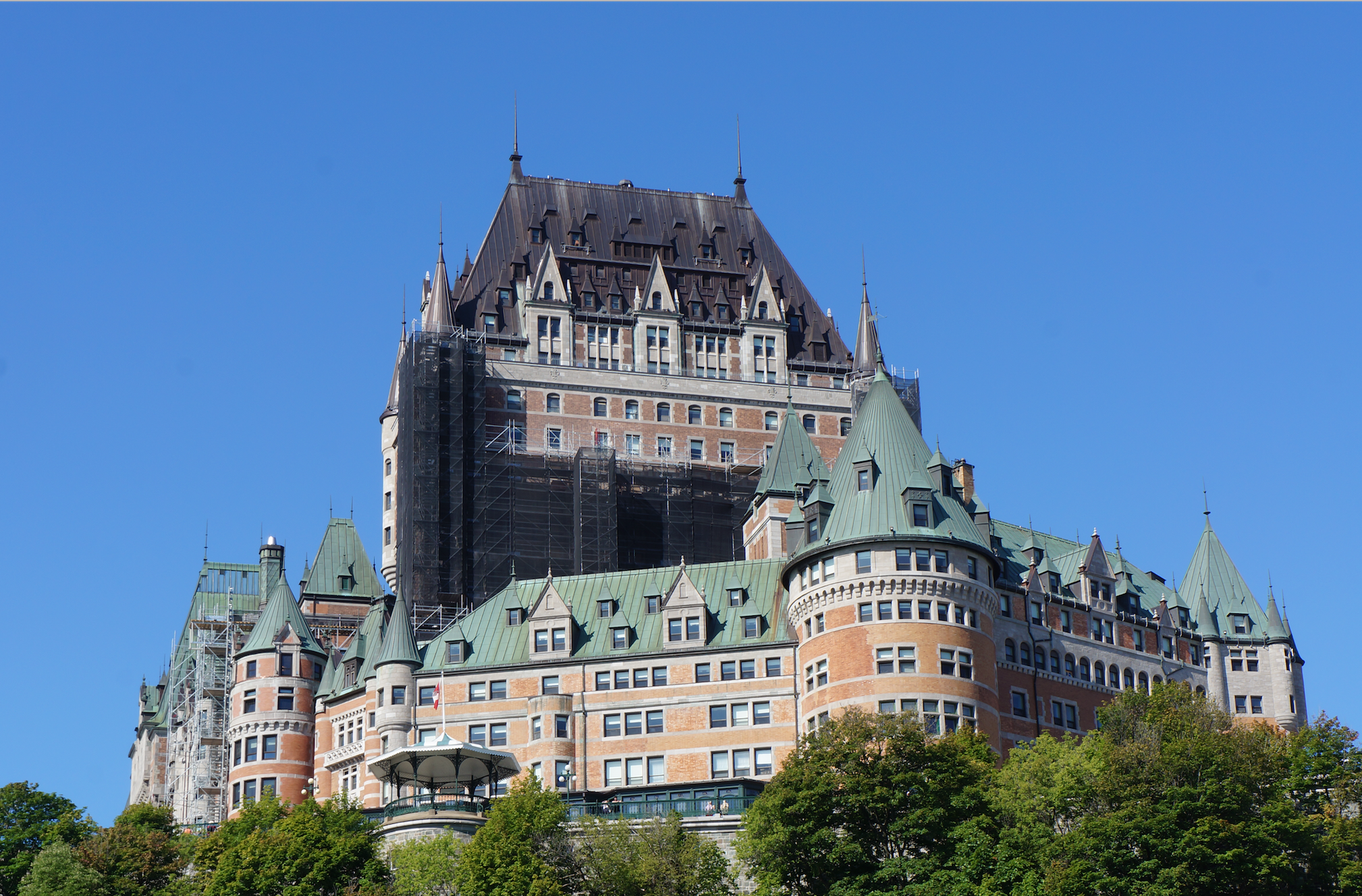
The old Quebec town is an interesting place. It is the oldest city in Canada and the historic buildings are interesting to look at. The stonework in walls of the buildings, the architecture in the various cathedrals and churches, the cobblestone streets, just make you feel you are back in France. The cathedral bell tolls every hour, on the hour. Overlooking the city is the Hotel Frontenac, reportedly the most photographed hotel in the world. Directly beside and behind it is the Citadel, the original fort. The entire old Quebec is ringed by the stonewalls of the fort and the present Citadel is a National Heritage Site and is still an opertional Canadian Military base. It is the home of the Royal 22 Regiment, the Van Doos.
Debbie shopped while I followed her from store to store. Shopping is far from my favorite thing to do, so I tried to make the most of this by looking at the many different sights on the street.
The popularity of this tourist attraction is unbelievable. All the sidewalks are filled three deep with tourists and shoppers, walking slowly along, looking in the windows and coming in and out of stores. All along the street are small taverns and bistros, with tables on the street, with people sitting and drinking wine and beer and talking.
Late in the afternoon, Debbie was finished shopping, I was tired of walking and we went to a small pub in the lower part of the city and enjoyed a bowl of soup and stew. We were only a half block from where we had decided to view the fireworks.
The fireworks were not starting until 10:00 so we found our perfect viewing spot on the cannon battery area overlooking the St. Lawrence River. Several freighters slowly sailed up and down River. We sat and “people watched”, the air was cooling forcing us to bundle up and put on our windbreakers.
The fireworks finally came on at exactly 10:00 and for the next 20 minutes put on a spectacular show. Then it was all over and the literally hundreds of thousands of people started walking out of the old quarter. Vehicles were not allowed into the old quarter during this time, forcing everyone to walk in and walk out to the various parking lots. We joined them, as we had a pre-arranged meeting place with Dave and Carly at the train station. The walk took us about 20 minutes but with a little help from some locals we found our way to the train station and Dave and Carly. The Uber driver arrived exactly at 11:00, and proceeded to drive us back to the campground. He must of thought that he was Mario Andretti by the way he drove, but frankly I think all Quebecers drive that way. We did get home safe and crashed into our bed, exhausted.
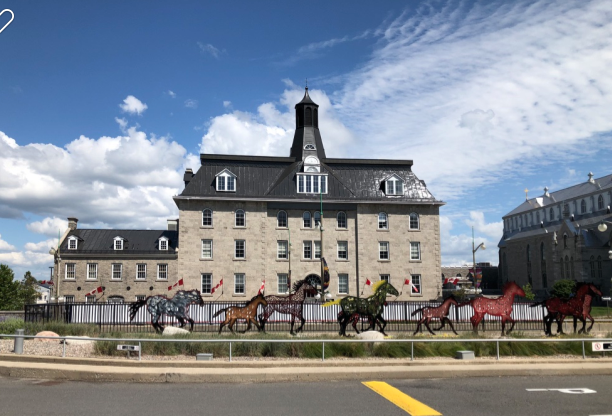
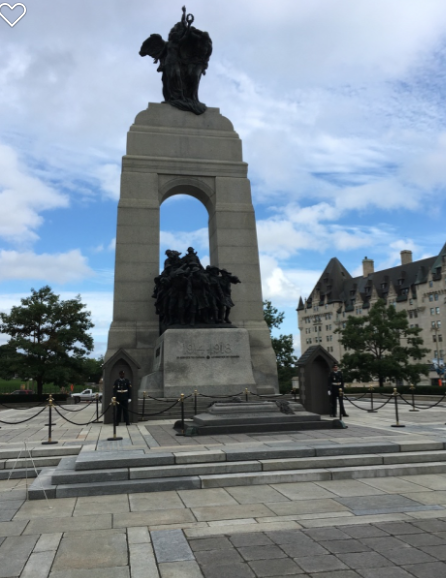
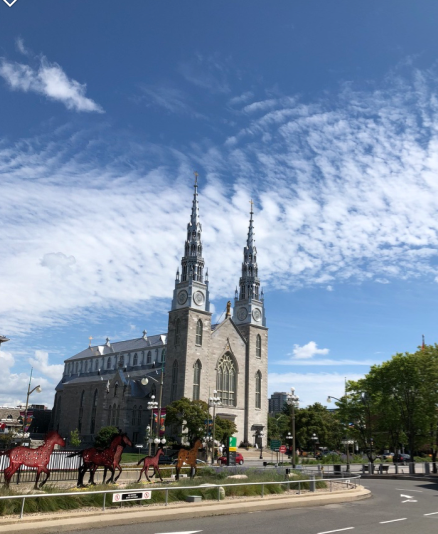
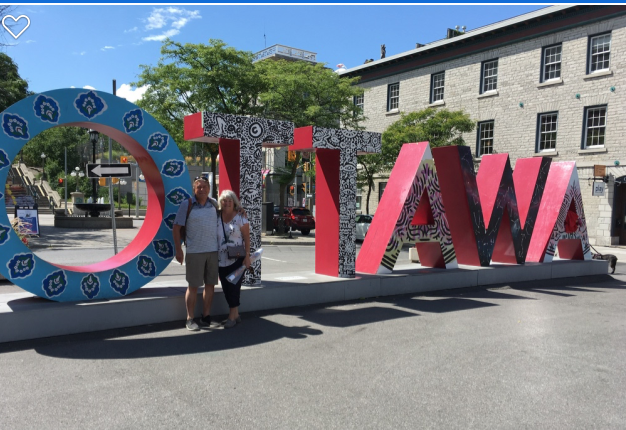
We are up early, shower and jump into the truck because we want to be in downtown Ottawa, to catch see the changing of the Guards at the Parliament buildings and then to jump onto the Hop On Hop Off bus. That meant we had to find an open-air parking lot downtown to accommodate our over-height vehicle. That chore to find the parking lot with an open space became a quest that took longer than we expected and we missed that show.
We bought our tickets for the bus and then started our tour of the city. We jumped off at various stops including the National Art Gallery. We are meeting Dennis there. Dennis is the father in law to a friend of Myra, our daughter. Dennis is planning an extended stay on Vancouver Island for September/October and we have offered our home to him for that period. Our visit was to meet him, get to know him a little and make the necessary arrangements.
We had a brief lunch at the Gallery, hopped back on the bus to tour more of the city. The narrator pointed out the many landmarks of Ottawa, various foreign embassies and historic sites, including the Rideau hall, the Governor General’s residence and the temporary home of the Prime Minister. (24 Sussex drive is presently undergoing a major upgrade and renovation).
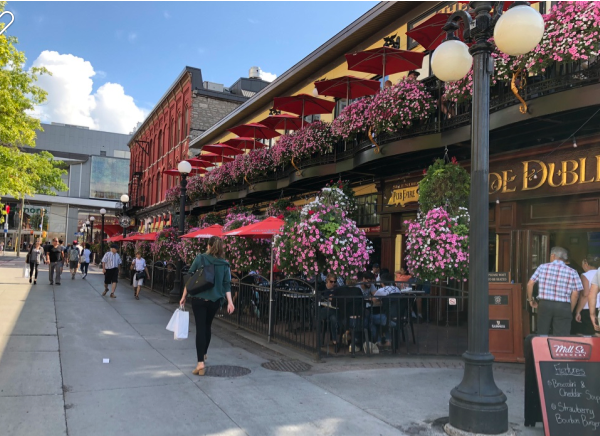
We stopped in at the ByMarket. This area of downtown Ottawa is a market that has many vendors, shops and eclectic things to see. As we were getting back on the bus we were stopped for a period of time as the cavalcade for the visiting US Secretary of State made its way down the streets from the US embassy.
After seeing the sights that are included in the bus tour, we jumped off and walked back to our truck to extend our parking meter to the late evening. We had decided to stay downtown to see the light show at the Parliament Buildings, at 9:30.
We walked up onto Sparks St and strolled with the crowds. There are many outdoor bistros on Sparks St. so we chose one and ordered a poutine and a beer. Not exactly a healthy supper but we enjoyed it. I’m sure my cardiologist has something to say about that! Ottawa is truly a great city with many parks, and green spaces. The Rideau canal certainly adds to the beauty of the city.
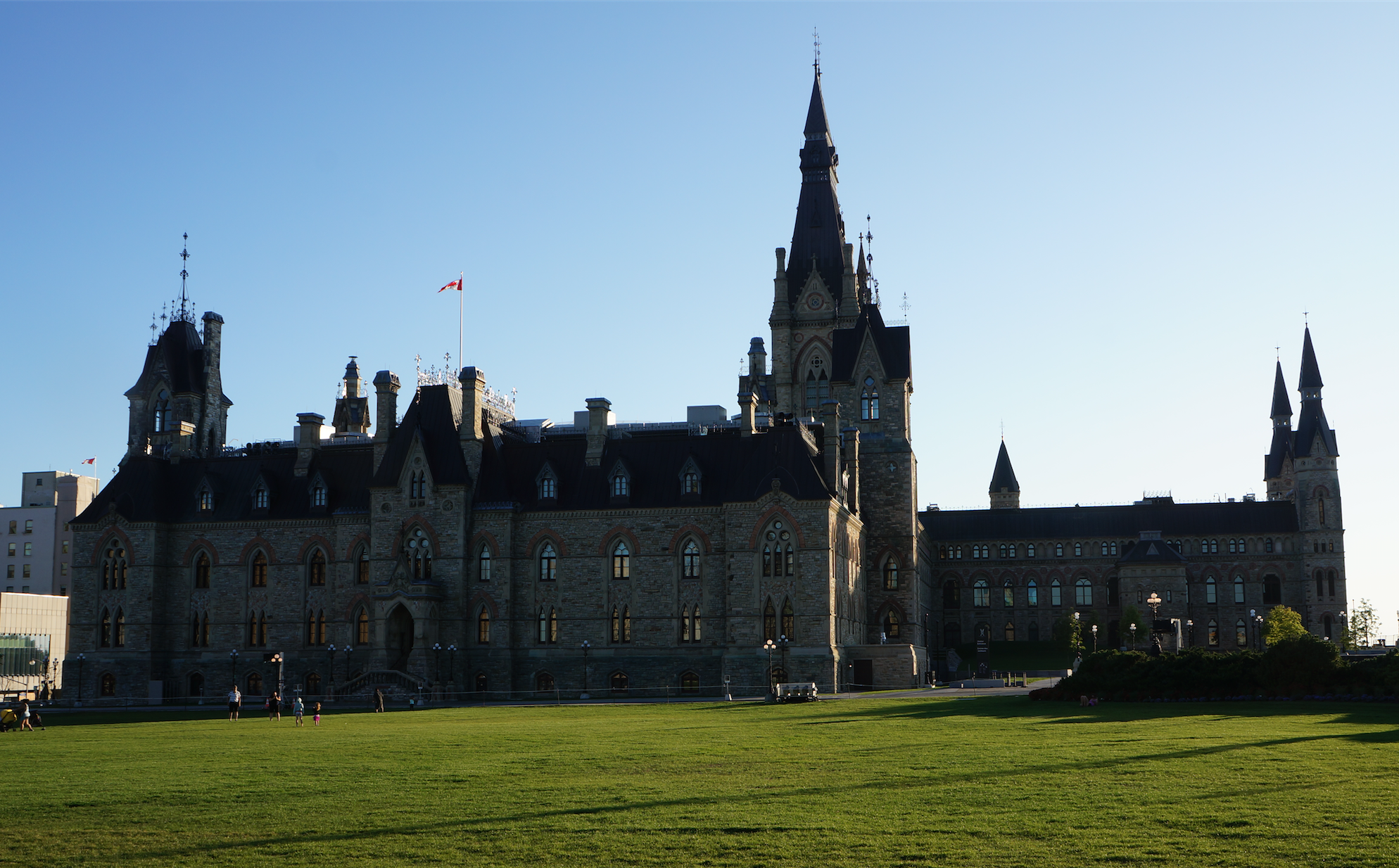
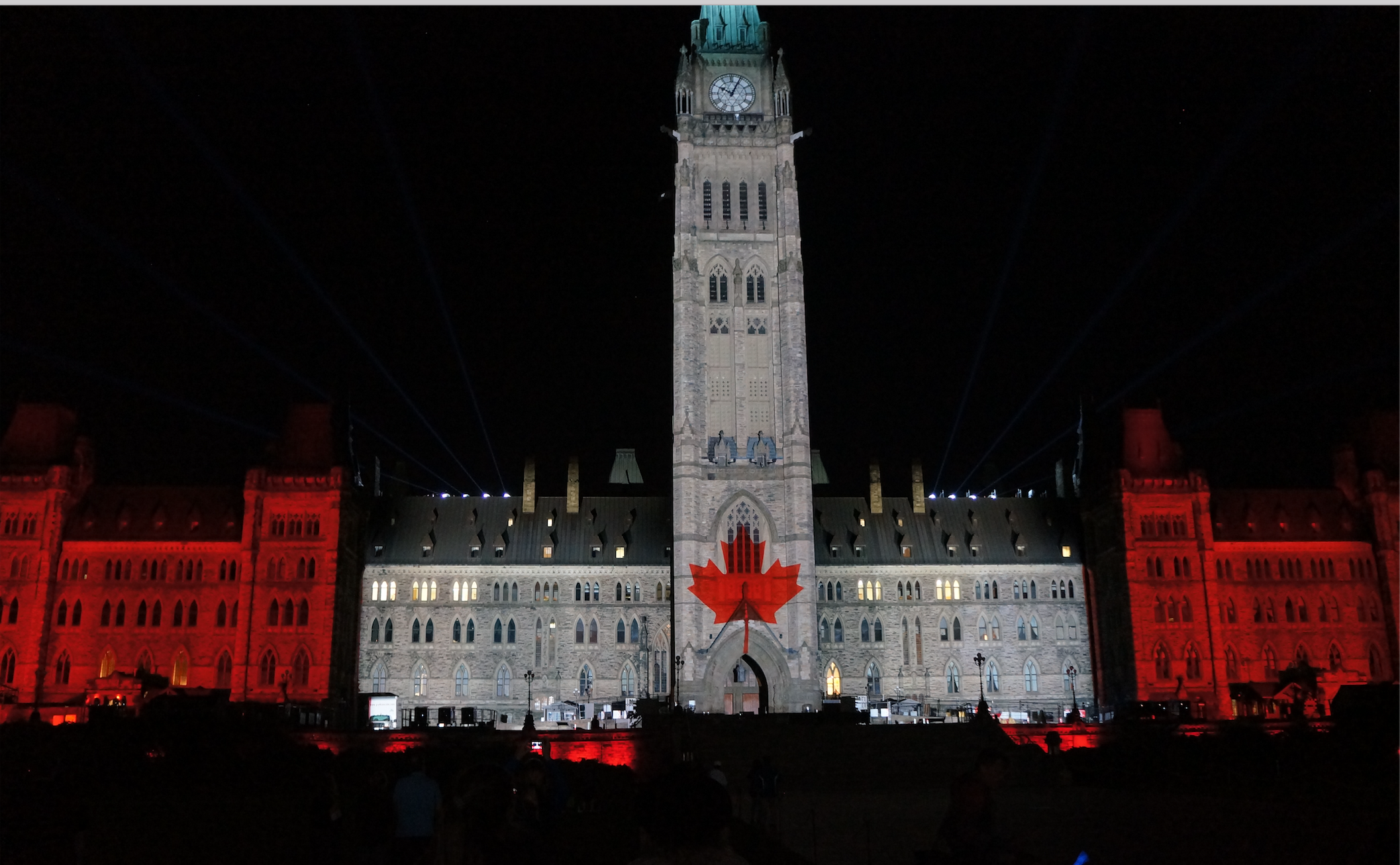
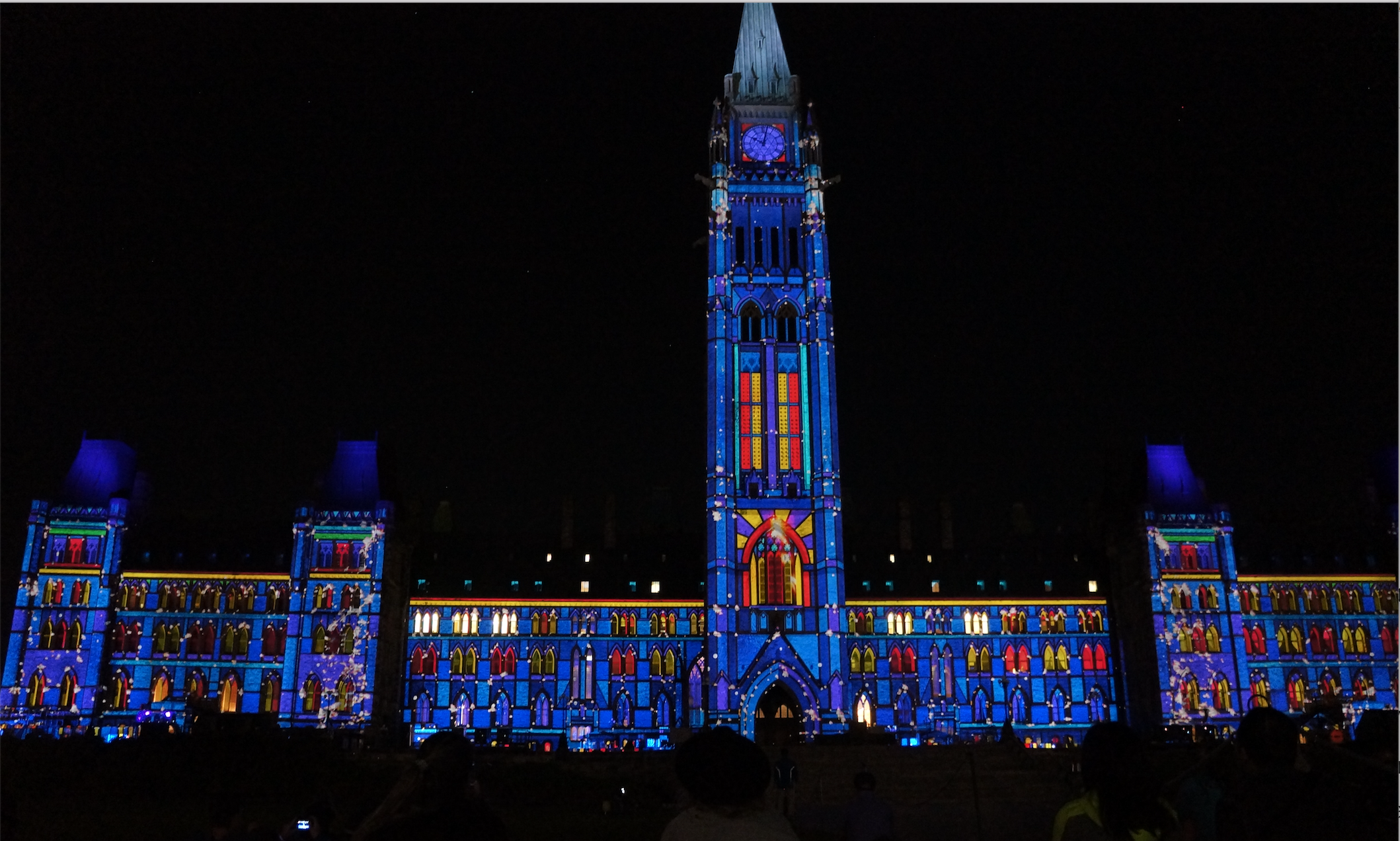
The Northern Lights show at the Parliament buildings is spectacular. The theme this year is the about the history of Canada featuring the many unique events that shaped the country and the culture of Canada. The entire show is projected onto the walls of the Centre block. By 9:30, the lawns in front of the building were covered with folks sitting down to watch the half-hour show. The show ended with the nation’s flag projected onto the Parliament building and the national anthem playing. The entire crowd spontaneously jumped to their feet to stand and sing along. It was truly a moving experience. We left, walking back to our vehicle feeling proud to be a Canadian.
Our drive home was filled with our conversation, reflecting on what we had seen and done. We were both tired and went to bed straight away.








 Quilting in a Kayak